
 EN
EN


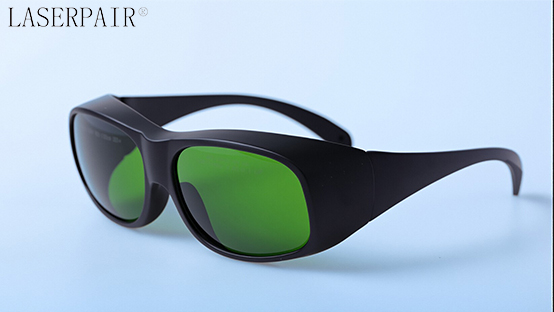
Tuned to Your Laser: Why You Need to Consider the Wavelength Your Laser Safety Goggles Match.
The physics of selective wavelength absorption: How filter materials interact with UV, visible, and IR light
Laser safety glasses use filters that absorb or reflect narrow bands of light. UV, visible, and IR light are absorbed differently by Polycarbonate, colored glass, and composite (often metallic) filters. A filter that absorbs 532 nm (green) light might allow the passage of 1064 nm (near-IR) light. The absorption mechanisms of the filters are wavelength dependent, and hence no one filter can protect against all laser wavelengths. Laser safety glasses certified against one laser wavelength provide no protection against different laser wavelengths, even if the light emitted is of a similar color.
Cases of Proper Optical Density (OD) but Incorrect Wavelengths Leading to Retinal Injury
In cases of retinal laser injury, it has been shown that mismatched wavelengths are more often the cause of injury than insufficient OD. In an example from the 2019 industrial world, three technicians developed permanent retinal injuries after exposure to a 1064 nm Nd:YAG laser. The technicians were fitted with safety goggles with an OD of 7 at 532 nm. Even though the goggles were designed for a high OD, the goggles’ 1064 nm transmission curve showed the goggles had a very poor laser OD. In the 2021 argon laboratory example, the 488/514 nm goggles with an OD of 5+ also showed a poor OD at 635 nm, allowing more than 90% of the 635 nm laser light to pass. The reason ther is a poor OD at 635 nm is that the goggles are designed for 488/514 nm. These examples illustrate that goggles designed with a high OD rating at a certain wavelength can still lead to retinal injury if there is a mismatch between the laser’s protective wavelength and the wavelength of the laser beam. Therefore, the selection of protective goggles should start with the protective wavelength and not OD alone.
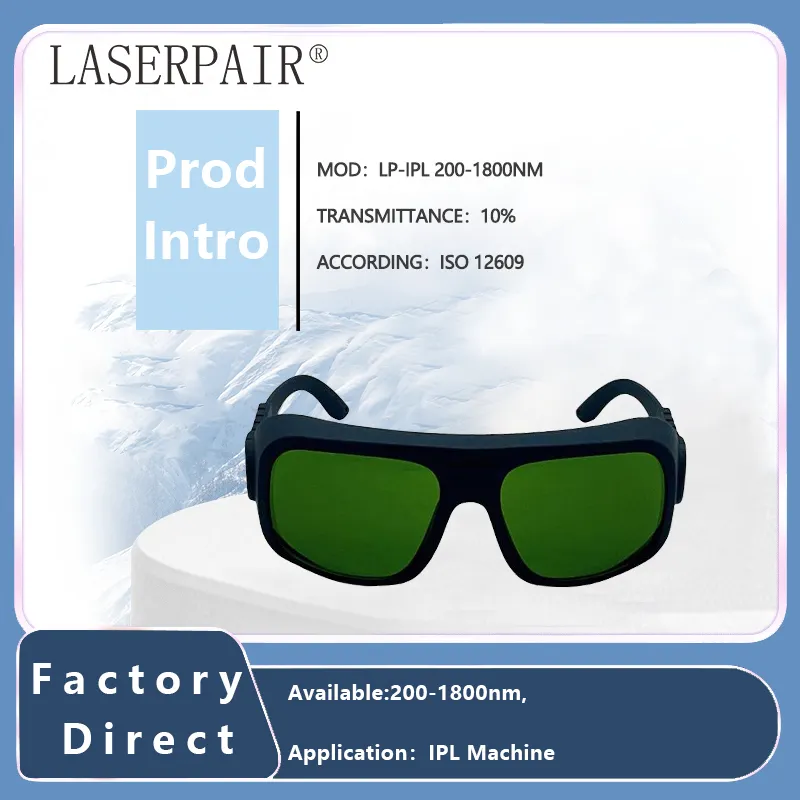
Calculating the Required Optical Density (OD) for Protective Goggles
To assess the required Optical Density (OD) to determine the risk of injury from exposure to a laser at a level greater than the Maximum Permissible Exposure (MPE) level, one must first obtain the laser type specifications and derive the burn threshold level. The Maximum Permissible Exposure (MPE) level is defined in ANSI 136.1 as a laser that sustains a threshold injury to a human being to a non-lethal level. To assess the required OD, the operator must determine the following variables:
1. The operating wavelength of the laser:
2. The output power of the laser or the energy per pulse of the laser:
3. The pulse duration of the laser (if applicable);
4. The beam diameter of the laser.
Lastly, one must assess the case of a Continuous Wave (CW) laser in terms of irradiance (power per unit area) in or terms of radiant exposure (energy per unit area) in the case of pulsed lasers.
Assign this value to the MPE for your specific wavelength and exposure duration. For example, the MPE for 10.6 µm CO₂ lasers under 10 s of exposure is 0.1 W/cm².
Use: OD = log₁₀ (incident irradiance ÷ MPE)
Consider a 50 W CO₂ laser of 10.6 µm operating with a 1 cm beam. The irradiance emitted from the laser is ~63.7 W/cm². To determine the necessary OD for an MPE of 0.1 W/cm², we calculate: log₁₀(63.7) = 2.8. In practice, we round/correct the necessary OD to a minimum of 3 (3+) for a safety factor. Safety OD 3+ is necessary because of alignment errors, reflections, filter degradation, and cannot be determined from a theoretical minimum.
Considerations for CW versus Pulsed Lasers: (Q-Switched and Ultrafast Lasers)
Continuous-wave (CW) lasers have reach set rating OD 6 at 1064 nm with slow CW operation. A laser Index of 3 for a 1064 nm CW laser, for example, may only provide protection OD 3 or 4 against a Q-switched pulse with the same average power.
Concerning multiphoton absorption and laser-induced breakdown of filter material, rating verifies under CW conditions may explain injuries where protection against CW CERT was considered valid. For pulsed lasers, protect against peak power flow using pulse specific isolation ratings as validated against standard EN 207.
When dealing with ultrafast lasers (>10⁹ W/cm² peak irradiance), LSO-reviewed test data or third-party reports confirming performance at your exact pulse parameters—not generic CW ratings.
Laser Selection Guide for Common Systems: CO₂, Nd:YAG, Diode, Excimer, and Fiber Lasers
Nd:YAG (1064/532 nm) and CO₂ (10.6 µm): Material compatibility, thermal limit, and ANSI Z136.1 certification considerations
CO₂ lasers emit at 10.6 µm. Being in the far infrared, filters must be made of polycarbonate or specialized glass which are laser absorptive. This differs from the visual and near infrared which are selective. High power CO₂ lasers (greater than 100 W) can damage poor quality optics. Choose goggles that are tested and rated for the CO₂ laser at the operating power level, not just the wavelength. For an Nd:YAG laser, protection at 1064 nm (corneal hazard) and the frequency doubled Nd:YAG at 532 nm (retinal hazard) is necessary. Many goggles provide protection at 1064 nm in compliance with ANSI Z136.1 and negligence at 532 nm, which has an MPE up to 100 times lower. Provide proof of certification of each wavelength, not in combination or under the term “broadband IR”. “General IR” goggles will have poor protection at 532 nm and therefore will not be compliant with ANSI Z136.1.
A trade-off comparison for Diode (405--980 nm), Excimer (193--351 nm), and Fiber (1030--1550 nm) lasers and reputable laser safety goggles.
Diode laser goggles require a filter for each laser emission. A filter verified for 450 nm provides no protection at 808 nm. The validated attenuation filter band must exactly match the laser emission. Excimer lasers (193 nm Argon-F, 248 nm Krypton-F, 308 nm Xenon-Chloride, and 351 nm Xenon-Fluoride) are in the deep UV range. Filters made of rare-earth–doped glass or fused silica and usually lose visibility by 70% to 90%. Compliance is impacted. Because of the 1030–1550 nm range that overlaps with Nd:YAG, fiber lasers usually operate at much higher average powers or ultrafast pulses. IR goggles prove sufficient for low power Continuous Wave (CW) fiber systems, but high power or pulsed systems demand filters from the EN 207 specification with a validation to your pulse duration and peak power. Prefer models with public third-party testing to your required operating specs, not marketing claims.
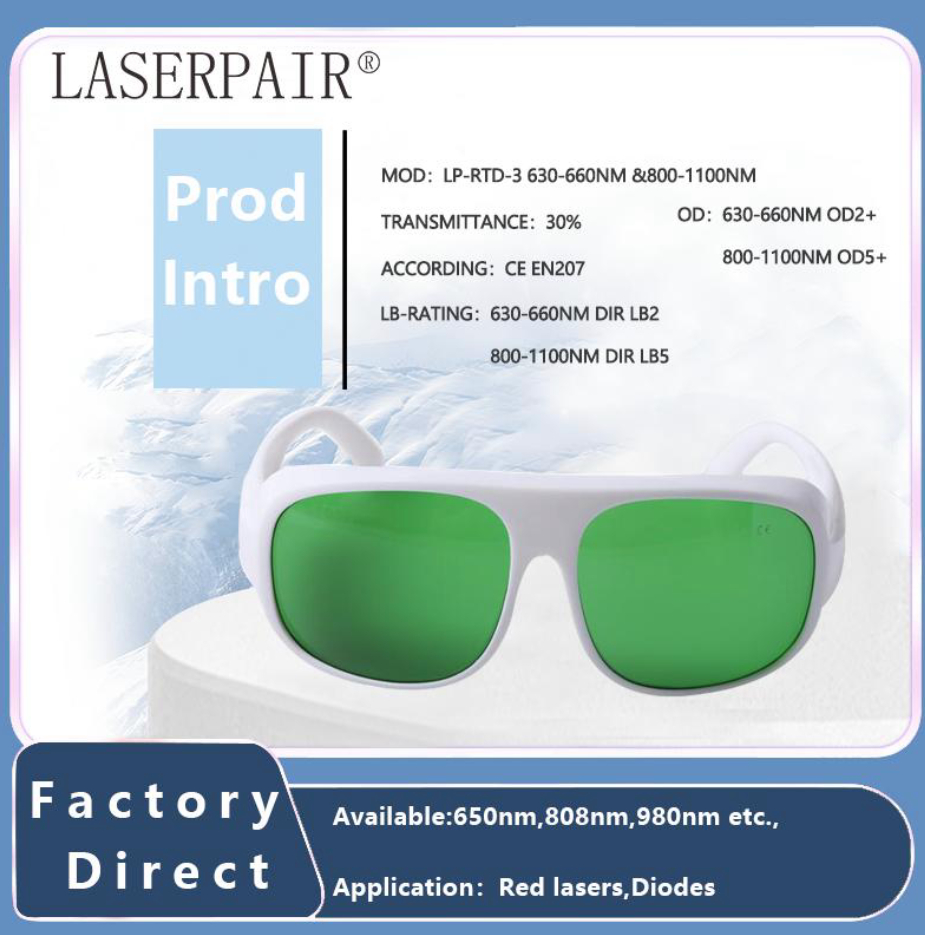
The use of Laser Safety Goggles involves Fit, Certification, and Use Context, and is an essential factor in ensuring their reliability in real-world settings. To reduce the risk of encountering blindness when using laser beams, it is important to wear laser safety goggles that are close-fitting. Gaps that may appear in the frame of the goggles are an entry point for beams in their direct or reflected form, and discomfort from prolonged use results in failure of the wearer to comply with safety regulations. Laser safety goggles must meet the requirements of the impact and laser standards, that is, ANSI Z87.1 (impact) and ANSI Z136.1 or EN 207/208 (laser attenuation and durability). For example, certified EN 207 goggles are tested at certain power/energy levels and certain pulse durations to assure real-world reliability. Laser safety goggles must be checked regularly for scratches, peeling layers, and warped frames, and should be replaced if their integrity is compromised. Lastly, use context and fit verification training should be incorporated to your laser safety program as they help reduce the chances of the goggles failing (when worn incorrectly) or failing to be worn (when not worn consistently).
FAQ
Why is laser safety goggles' wavelength-specific tuning important?
Laser safety goggles' wavelength-specific tuning is important because goggles are designed to filter lasers that fall within a narrow band, and are optimized to protect against laser wavelengths that fall within that band. If the goggles fall within that range, they likely would provide little to no protection.
What will happen if I wear goggles that are certified at the wrong wavelength?
Wearing laser safety goggles that are certified at the wrong wavelength will likely cause the laser to cause retinal burns or permanent damage.
How do the safety goggles' Optical Density (OD) relate to laser safety?
The Optical Density (OD) of laser safety goggles is the degree to which a safety goggle must attenuate the safety laser to prevent their exposure from falling within the Maximum Permissible Exposure (MPE). Therefore, the safety goggles must be designed for a specific laser wavelength.
Are pulsed and continuous wave lasers do different lasers require different goggles?
Yes, continuous wave goggles may mislead when dealing with pulsed systems. Because of their high energy density pulsed lasers require goggles rated for peak irradiance.
What would be the best way to maintain laser safety goggles?
You may confirm your safety goggles for laser use fit properly and do not show signs of damage. Safety goggles for use with lasers should meet these standards: ANSI Z136.1 and EN 207.