
 EN
EN


What Does CE Certification Mean for Laser Safety Glasses?
CE certification is mandatory if laser safety glasses are released in the European Union. It confirms the product fulfills certain health and safety specifications as per the European Directives, including the Personal Protective Equipment (PPE) Regulation (EU) 2016/425 and the Machinery Directive. Compared to other products that meet CE marking requirements through self-declaration, laser safety glasses must be assessed by a Notified Body to receive the CE marking. That means rigorous testing to ensure that the glasses provide protection against hazardous laser radiation in both wavelength and pulse for the user, rather than general protection.
Three Standards for Laser Glasses
CE marking requirements are fulfilled by three European standards.
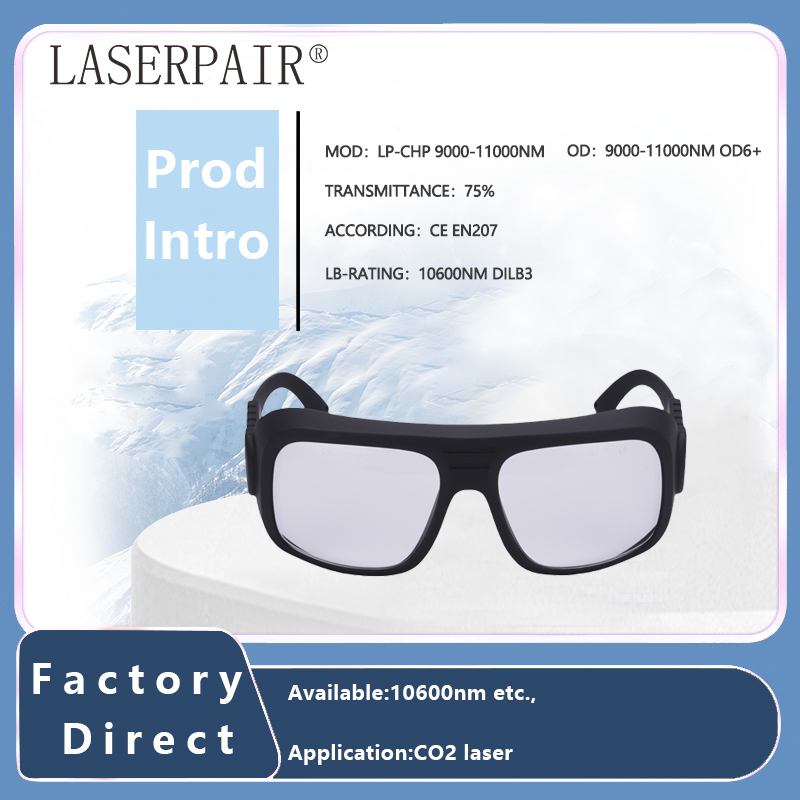
EN 207 describes the requirements for laser safety glasses that are meant to offer protection against hazardous laser radiation. Tests must be performed to assess the glasses’ optical density (OD) as well as their damage threshold protection (LB rating). The safety glasses must exhibit a permanent marking, and the testing authority must provide the certification.
EN 208 describes the requirements of safety glasses meant to protect against lower level lasers. When the main risk is glare and not retinal damage, these glasses can be assessed at lower energy thresholds and must allow a visual transmission in the laser’s wavelength in order to permit beam manipulation.
EN 60825-1 describes the classification of lasers and their corresponding risk levels (Classes 1-4) and outlines the various protective measures, including the selection of appropriate PPE. It is important to note that while it is not a product standard in and of itself, it does help give context of the risk in the use of EN 207 and EN 208.
These standards mean that the testing of CE-approved laser safety glasses occurs under the realistic operational conditions. This means that the testing is done for the exact wavelength, pulse duration (continuous wave, pulsed, mode locked), and power/energy density of the laser systems.
CE Mark ≠ Universal Protection: Why Application-Specific Validation is Important
The CE mark does not guarantee protection in every way. Each certification states only the specific bounds of the item, to which there is a range of discrete wavelength, exposure modes (continuous wave, nanosecond pulse and the like), as to the maximum irradiance and radiant exposure. If CE-marked glasses are used outside the bounds of certification, for instance, if the EN 208 alignment glasses are used for Class 4 laser operation, there can be filters that fail completely and cause irreversible injuries to the eyes.
That’s why a label alone cannot be fully trusted. Safety managers must ensure the eyewear holds the correct certification markings to be authorized for the laser's output in terms of wavelength, pulse width, repetition rate, and maximum accessible emission limit (AEL). Application-specific validation elevates CE compliance from being a procurement formality to a legitimate safety measure.
Wavelength and pulse specific protection can be provided by CE-certified laser safety glasses through a combination of the safety glasses’ optical density and LB ratings.
Laser safety glasses are often chosen in part due to some combination of their features and their optical density (OD). An OD of 6 means that the intensity of the laser is reduced by a factor of one million. However, it does not indicate whether direct exposure will be damaging or will cause a failure of the filter material. A high OD does not mean that there will be no thermal cracking or melting or ablation of the filter material. An OD rating of 6 may be sufficient to meet beam safety, but not filter safety requirements.
Why Being Overly Dependent on OD Is Problematic. EN 207’s LB Rating: A Better Approach to Wavelength, Pulse Duration, and Energy Density.
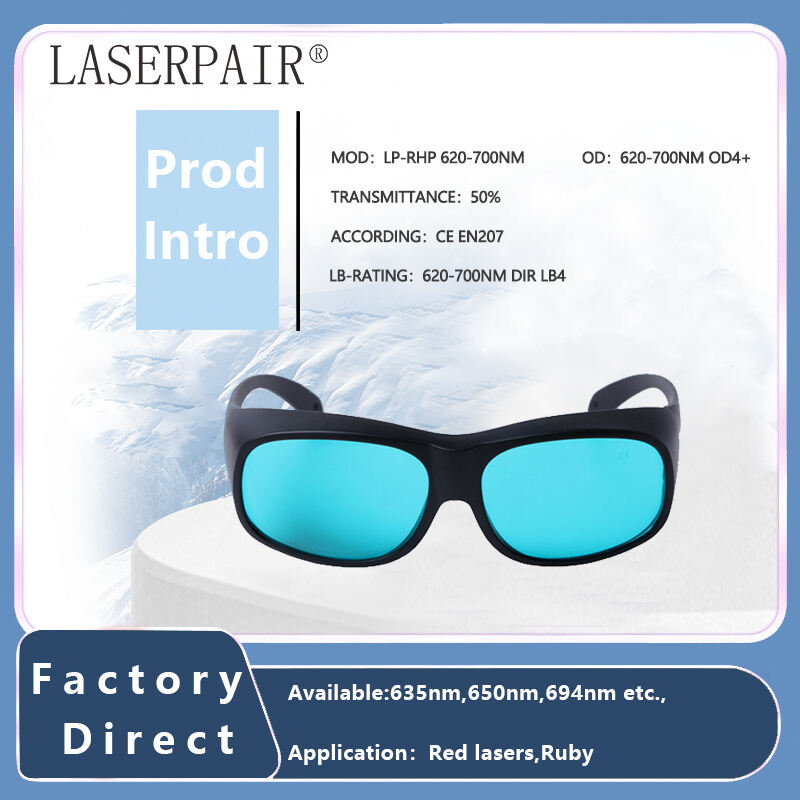
The EN 207 standard is the first to include the LB rating to address this deficiency. While OD is completely photometric, the LB number is an indicator of the laser damage threshold for the entire laser assembly (lens, frame, and housing). In order to obtain an LB rating, the eyewear must be able to endure 5 seconds of exposure to a continuous-wave laser or 50 laser shots without the laser's optical density decreasing by a factor of more than 10.
The LB rating consists of three components:
- a letter corresponding to the type of exposure (R = Continuous Wave (CW), M = pulsed, I = mode-locked, and U = ultrashort),
- a number that indicates the level of required optical density (OD) for a certain wavelength, and
- a wavelength band (for example, LB635–650).
As a general rule, the LB number will always be lower than the LB number. For instance, LB6 at 1064 nm would require an optical density of ≥7. This provides a safety buffer for both radiant exposure and thermal exposure. For this reason, the LB rating should be considered the most important factor in the overall assessment of the CE markings of laser safety glass for real-world applications.
How to Choose the Right CE-Certified Laser Safety Glasses: Fit and Function, in the Real World
CE certification provides a valuable baseline, but for real-world safety, flourish, and fit are essential. Protection is negated when eyewear is unpleasant or obstructs vision and even modifies the PPE. Eyewear that is discomforting not only fails to protect but also discourages the user from using it. This drives 42% of non-compliance incidents in industrial environments (Journal of Occupational Safety, 2023).
Beyond Compliance: Comfort, Field of View, Compatibility with Respirators and Face Shields
Fully functional laser safety glasses combine the protection needed with an understanding of user experience and engineering. Some components include:
Comfort engineering: Extended wearing designs, sub 30g designs, silicon nose bridges, and pressure-diffusing tips. Polycarbonate lenses are lightweight and impact-resistant. Glass alternatives are optimal for opthalmic or micromachining laser applications.
Field of view optimization: Panoramic lens designs should maintain greater than or equal to 160 degrees of horizontal field of view without chromatic distortion. Anti-fog coatings tested per ISO 16371-1 are crucial for elevated environments and those with high levels of respiration.
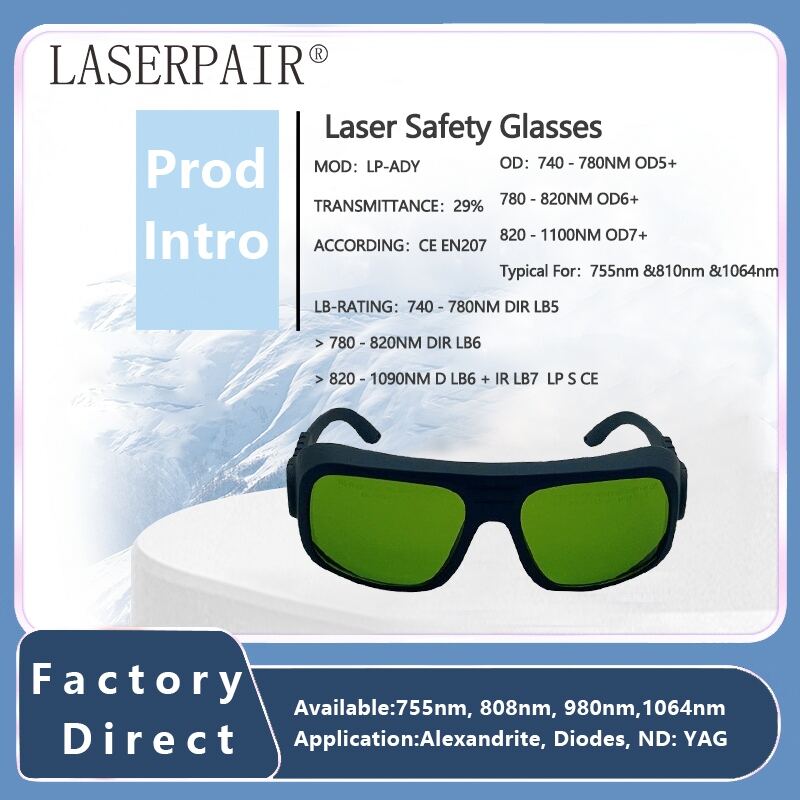
Integrated protection systems: Modular designs can accommodate N95 respirators without breaking the facial seal, as well as accommodate side shields for complete coverage when used in conjunction with face shields or helmets.
When weighted, these features reduce safety breaches by more than 63 percent from strategies that prioritize compliance alone. The table below summarizes usability priorities from different settings.
Feature Industrial Impact Medical Requirement
Seal integrity Critical Critical
Fog resistance High Extreme
Peripheral vision Moderate Extreme
The Role of the Laser Safety Officer in Validating and Enforcing CE-Certified Laser Safety Glasses Use
The Laser Safety Officer (LSO) is the sole authority for ensuring that each pair meets the CE standard required in order for them to operate in conjunction with a compliant laser system. According to IEC 60825-1 and ANSI Z136.1, the LSO must confirm that the EN 207 or EN 208 labels are appropriate to the operating criteria of the laser - to include wavelength, pulse duration, repetition rate, and maximum output - and the LB rating and OD values are sufficient to exceed calculated levels.
Other than verification, the LSO mandates use during all laser operations, performs regular inspections of the condition of eyewear, and checks the certification records. The LSO can suspend use of the laser if the eyewear is absent, broken, or incorrectly used. This continual supervision ensures that certification by CE is an active protection system and not an inactive prototypical safeguard.
Frequently Asked Questions
CE Certified Laser Safety Glasses
What protection does CE provide?
CE protection allows access to the certification of safety glasses in the European Union and ensures that the safety of the user is not compromised. The safety glasses are tested by an accredited Notified Body to ensure protection is provided in regard to the laser's wavelength and pulse.
How do I select safety glasses for my laser systems?
Safety glasses protection must be verified concerning certification of the laser used. Review parameters such as the laser's pulse width, safe parameters, and the operational parameters.
Are CE-certified glasses protective?
CE-certified glasses protect in regard to the specific mode of exposure. Worn in the wrong manner, the filter may become dysfunctional.
Why is optical density insufficient
Optical density is insufficient because it only measures beam attenuation. It does not safeguard against the glasses' failure when exposed to thermal stress. EN 207's LB ratings adjust for real-world conditions.
What is the obligation of the Laser Safety Officer (LSO)?
The LSO is tasked with ensuring that the safety eyewear is used in the operations pertaining to the laser. The LSO is also obligated to conduct audits in order to facilitate the enforcement of the safety framework.