
 EN
EN


Engineering Controls: Designing ISO-Compliant Enclosures for Kilowatt-Class Laser Welding
Structural Integrity and Light-Tightness Requirements for Class 4 Laser Enclosures
When dealing with Class 4 lasers (500W and above), proper enclosure design becomes absolutely critical. According to ISO 11553 standards, these enclosures need to handle impact forces around 9.8 kPa without letting any radiation escape through seams, joints, or where panels connect. Most manufacturers go with high quality steel or reinforced aluminum alloys because they stand up better to the mechanical stresses and temperature changes that happen day after day in operation. Getting light tightness right isn't optional either. Every surface counts including those pesky doors, viewports, and service panels. The goal here is to keep transmission below 0.1% across all wavelengths the system operates on. Why does this matter so much? Well, studies show diffuse reflections are responsible for nearly 4 out of 10 laser eye injuries according to Journal of Laser Applications last year. That's why good designs incorporate interlocked access panels, those complex labyrinth seals, and precision machined flanges everywhere possible. And when working with kilowatt level systems, don't even think about using anything thinner than 14 gauge steel as the main structural component. Anything less just won't cut it in real world conditions.
Beam Path Containment Strategies: Windows, Shields, and Scatter Mitigation in Industrial Settings
Effective containment goes well past just managing the main beam, it also handles those tricky scattered and reflected rays which becomes really important when working in areas with lots of reflective materials during welding processes. The polycarbonate windows we install come equipped with special filters tuned to specific wavelengths, giving us an optical density rating above 8 at 1070 nm wavelength, which ticks all boxes according to ISO 11553-2 standards for fiber lasers. Around our workstations, we've placed angled shields that bounce back about 98.7 percent of any stray energy straight into designated beam dump areas. Inside these systems, applying matte coatings that don't reflect light cuts down on unwanted reflections by roughly two thirds compared to regular metal surfaces without treatment, according to research published in Laser Safety Journal last year. For spots where there's extra danger like close proximity to robotic welding heads or shiny fixtures, we implement double layer protection. This gives us backup if anything slips through, fulfilling what ISO 11553-2 asks for in terms of having several separate safety mechanisms in place.
Laser Safety Eyewear: Selecting Optically Dense Protection for Invisible Infrared Hazards
Matching Optical Density (OD) to Fiber Laser Wavelengths, Power Density, and Exposure Scenarios
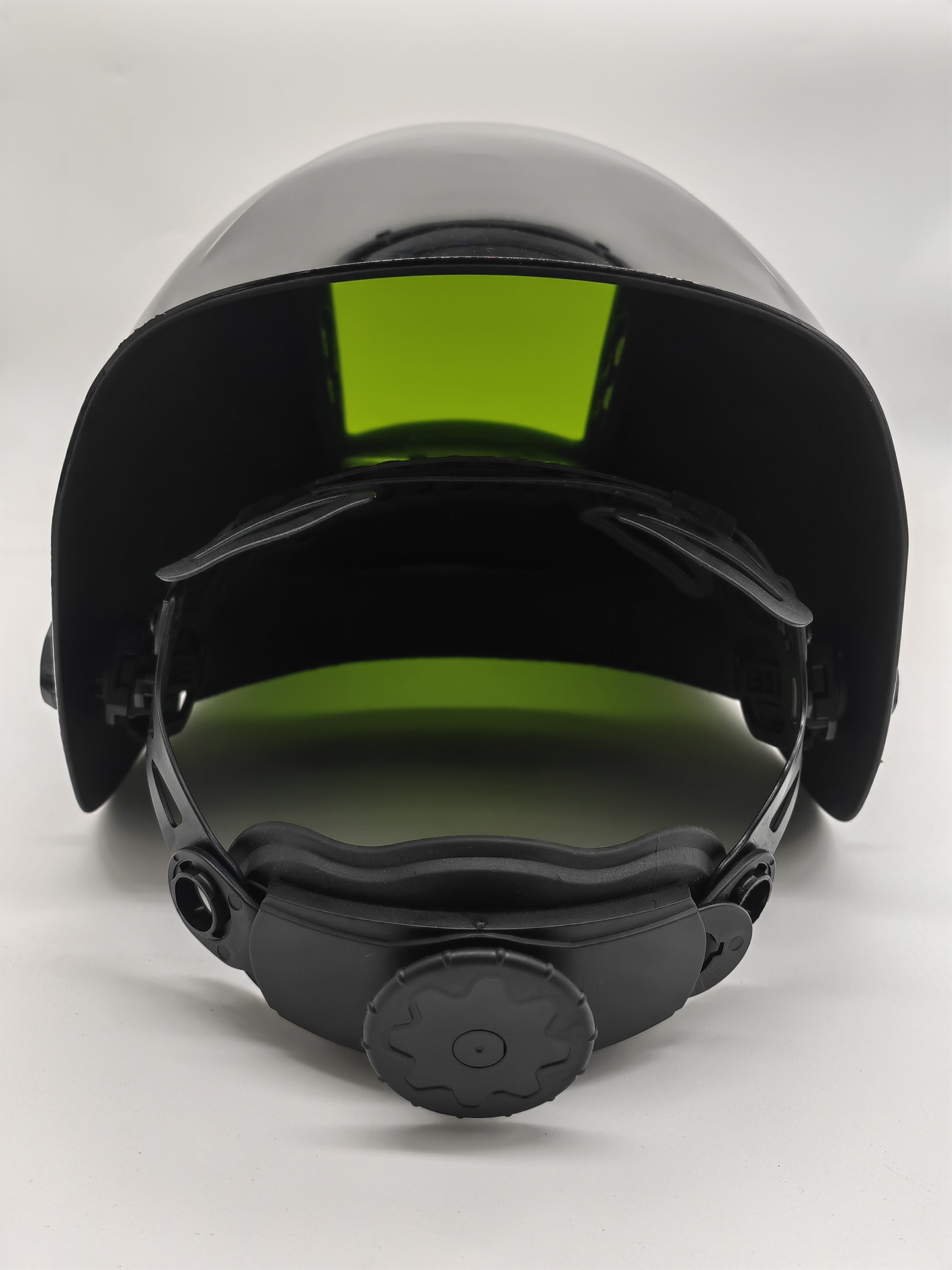
Picking the right laser safety glasses requires getting the Optical Density (OD) just right for whatever infrared risks come with fiber laser welding work. When dealing with those 1070 nm systems we see so often in Yb:fiber lasers ranging between 1 kW all the way up to 20 kW plus, the eyewear needs at least OD 7 protection. This ensures that whatever light gets through stays under the safety thresholds set by ANSI Z136.1-2022 for Maximum Permissible Exposure. There are several key things to look for when choosing this gear:
- Power density: Lasers exceeding 6 kW typically require OD 8+ for incidental exposure scenarios
- Exposure duration: Brief reflections demand higher OD than controlled, continuous operations
- Wavelength specificity: Filters must target the exact emission band (e.g., 1030–1080 nm), not just nominal center wavelengths
Polycarbonate lenses with embedded dye formulations enable targeted IR absorption while preserving ≥25% Visible Light Transmission (VLT), supporting operator situational awareness without visual compromise.
Why Retinal Injury Risk Is Elevated in High-Power Welding — and How Proper Eyewear Prevents It
The infrared laser radiation at around 1070 nanometers creates a particularly dangerous situation for the eyes. People cannot see this wavelength at all, but when it enters the eye, the lens actually concentrates it onto the retina with something like 100 thousand times more intensity than normal. During high power welding operations, even small amounts of reflected light bouncing off metal surfaces might surpass maximum permissible exposure limits within just a few milliseconds. There's also the issue of plasma flashes happening during what's called keyhole mode welding, which adds another layer of danger because these flashes emit both ultraviolet and infrared radiation across a wide spectrum. That's why workers need to wear appropriate protective eyewear designed specifically for these wavelengths. Without proper protection, serious eye damage can occur almost instantly.
- Attenuating >99.99999% of incident 1070 nm radiation (OD 7)
- Blocking photothermal damage pathways to retinal pigment epithelium and photoreceptors
- Providing consistent protection across variable beam geometries and reflection angles
Documented implementation shows correctly specified eyewear reduces laser-induced eye injuries by 92% in industrial settings (Journal of Laser Applications, 2023).
Automated Safety Systems: Interlocks, Sensors, and Real-Time Controlled Area Management
Door, Curtain, and Access Interlocks: Ensuring Automatic Laser Shutdown per ANSI Z136.1–2022 and ISO 11553
Redundant interlocking systems are essential for kilowatt-class laser welding cells. Integrated position sensors, electromagnetic door locks, and Type 4 light curtains enforce immediate, hardware-based laser shutdown upon any breach of physical barriers. As required by ANSI Z136.1–2022 and ISO 11553, these systems execute four fail-safe actions:
- Cutting laser power within ≤0.5 seconds of access violation
- Requiring manual reset and system verification before restart
- Maintaining full hazard-zone lockdown until clearance is confirmed
- Triggering simultaneous visual and audible alarms
This architecture reduces exposure incidents linked to procedural lapses or misjudged access by 94%, according to aggregated 2024 industrial laser incident data.
Defining and Monitoring the Nominal Hazard Zone (NHZ) for 6–20 kW Fiber Laser Cells
The Nominal Hazard Zone (NHZ) defines the spatial boundary beyond which laser radiation drops below MPE limits. For 6–20 kW fiber laser welding cells, NHZ boundaries expand significantly due to three interrelated factors:
- Diffuse reflections from polished or molten metal surfaces (increasing effective hazard radius by 50–70%)
- The invisibility of 1070 nm radiation, eliminating natural blink-and-aversion responses
- Dynamic beam paths introduced by multi-axis robotic manipulators
NHZ management systems now integrate LiDAR mapping alongside thermal cameras to track where people are moving around changing danger areas. The technology watches for changes in laser settings like focus distance, output strength, and scanning rates. Whenever these parameters change, the safety system updates its boundaries automatically, keeping everything aligned with the requirements set out in ISO 11553-2 regarding restricted movement areas. What makes this approach so effective is that it triggers emergency shutdowns well before workers get too close to hazards. This bridges the old way of doing risk assessments on paper with what actually happens during operations when conditions can shift rapidly.
FAQ
What are the key requirements for Class 4 laser enclosures?
Class 4 laser enclosures must handle impact forces around 9.8 kPa and maintain light-tightness with transmission below 0.1%, as per ISO 11553 standards.
Why is optical density (OD) important for laser safety eyewear?
Optical density (OD) is crucial as it determines the protection level against laser wavelengths, ensuring that exposure remains below safety thresholds.
How do automated safety systems improve laser operation safety?
Automated systems employ interlocks, sensors, and real-time monitoring to enforce immediate shutdowns and manage hazard zones, significantly reducing exposure incidents.