
 EN
EN


Understanding Laser Hazards to Eyes and Skin
How Laser Radiation Interacts with Biological Tissues
How laser light affects eyes and skin really depends on two main factors: wavelength and how concentrated the beam is. Our eyes have this amazing focusing power that can actually make retinal exposure hundreds of thousands of times stronger than what hits the cornea first. That means even seemingly harmless low power lasers can cause serious damage if they get into someone's eye. When it comes to skin contact, certain infrared wavelengths such as those around 1070 nanometers go much deeper into tissue layers, sometimes reaching depths of about six millimeters. This penetration makes them far more dangerous for causing heat-related injuries beneath the surface compared to regular visible light from everyday sources.
Mechanisms of Ocular and Dermal Damage
Lasers in the visible spectrum range from 400 to 700 nanometers and they work by targeting those tiny receptors in the retina, which leads to something called photothermal coagulation. Meanwhile, near-infrared beams between 700 and 1400 nm actually manage to get past the cornea and cause damage to the retinal pigment epithelium layer underneath. When we look at ultraviolet lasers, these create chemical changes in the skin tissue, and interestingly enough, the threshold for redness or erythema can be surprisingly low around just 50 joules per square meter when dealing specifically with 308 nm wavelengths. What makes infrared beams so dangerous is their double threat nature. They can hurt the eyes without warning because there's no natural blink reflex to protect against them, plus they also cause skin burns that people might not even realize are happening until it's too late.
Case Study: Retinal Injury From Misaligned Low-Level Lasers
A 2023 review revealed that a misaligned 5 mW diode laser caused permanent central scotoma after 0.8 seconds of retinal exposure. This aligns with research showing melanin-rich retinal tissues absorb 60% more energy at 532 nm, accelerating thermal damage.
Trend: Rising Skin Burns in Dermatology Clinics
High-intensity fractional CO2 lasers (10,600 nm) contributed to a 34% increase in second-degree burns in U.S. clinics from 2021 to 2023. Most incidents involved pulse durations exceeding the ANSI Z136.3 maximum permissible exposure limit of 0.1 seconds for ablative procedures.
Strategy: Real-Time Exposure Monitoring Systems
FDA-cleared devices now combine spectral sensors with AI to monitor cumulative UV/IR exposure. Pilot implementations across 12 hospitals reduced accidental exposures by 82% through instant alerts when radiation approached MPE thresholds.
Protective Eyewear and Optical Density Requirements
Wavelength-Specific Risks Requiring Tailored Eye Protection
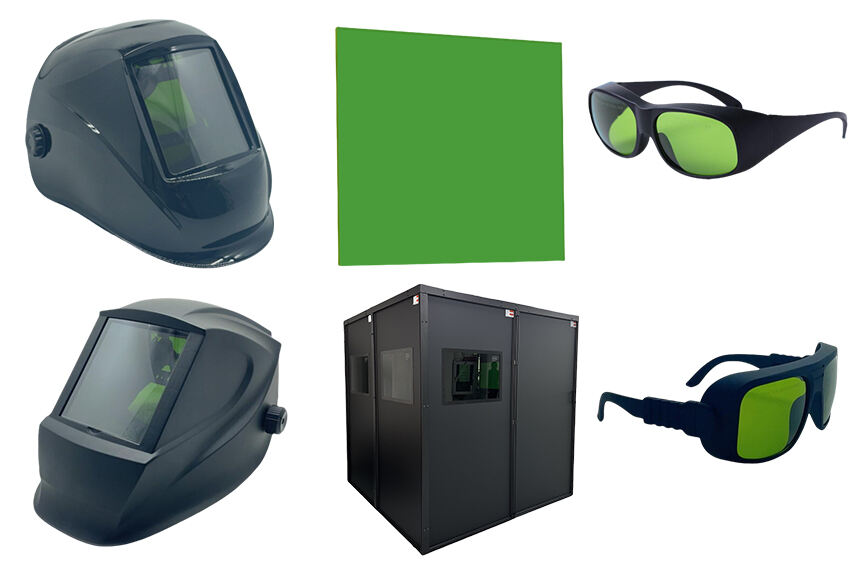
Different medical lasers work at specific wavelengths, CO2 lasers typically operating around 10,600 nanometers while Nd:YAG lasers sit closer to 1,064 nm. Because of these differences, proper eye protection is absolutely essential for anyone working with them. Recent research from 2023 shows that nearly half (about 42%) of all eye injuries happen when people wear the wrong kind of safety glasses for the job. Most polycarbonate lens materials do a good job blocking ultraviolet and visible light ranges, but they fall short when dealing with infrared radiation beyond 1,500 nm wavelength territory. That's why many professionals still rely on traditional glass filter technology for complete coverage. Industry regulations like EN 207:2018 have stepped in to address this problem by requiring manufacturers to clearly mark what wavelengths their protective equipment actually covers along with appropriate laser classification ratings (like D-LB). These labeling requirements help reduce mistakes when selecting the right gear for different laser applications.
Calculating Required Optical Density for Class 4 Lasers
For Class 4 surgical lasers, required optical density (OD) is calculated as:
$$ \text{OD}{\text{required}} = \log{10}\left(\frac{\text{Incident Power Density}}{\text{MPE}}\right) $$
At 10,600 nm, a 150W CO2 laser requires OD ≥6 to reduce exposure below the ANSI Z136.1 retinal limit of 0.1 J/cm².
Case Study: Near-Miss Prevented by Compliant Eyewear During CO2 Laser Surgery
In 2022, an anesthesiologist avoided retinal injury when a reflected 80W CO2 beam struck EN 207-compliant goggles (OD 6, #D-LB 10600). The eyewear attenuated the beam to 0.0008W—well below the 0.1W/cm² MPE threshold.
Trend: Adoption of Smart Goggles With Integrated OD Indicators
Smart eyewear now features embedded photodiodes for real-time OD verification, auto-darkening filters activating within 0.3 seconds, and audible alerts for wavelength mismatches. A 2024 trial showed these systems reduced eyewear errors by 67% in multi-laser operating rooms.
Strategy: Standardizing Eyewear Selection Protocols Across Departments
Leading healthcare networks enforce standardized protocols including laser-specific eyewear inventories tagged with wavelength and OD data, pre-procedure checklists matching equipment to protection, and quarterly attenuation testing. This approach eliminated 92% of improper eyewear use in a 12-hospital study published in the Journal of Clinical Engineering (2023).
Regulatory Standards and Compliance in Medical Laser Safety
Global variation in medical laser regulation enforcement
Regulatory enforcement varies significantly: the EU enforces strict beam containment under MDR 2017/745, while U.S. facilities follow FDA 21 CFR 1040. Developing nations often blend IEC 60825-1 guidelines with local adaptations, complicating compliance for global device manufacturers.
Key requirements from ANSI Z136.3 and IEC 60825-1
The ANSI Z136.3 standard requires certified Laser Safety Officers (LSOs) and quarterly inspections for healthcare settings. Its international counterpart, IEC 60825-1, mandates visible warning systems in active laser zones and standardized labels indicating wavelength-specific optical density needs.
Case Study: FDA inspection outcomes in U.S. hospitals
A 2023 FDA audit found 38% of inspected hospitals lacked proper maintenance logs, and 12% used expired protective eyewear. Facilities using digital tracking systems reduced repeat violations by 67% within six months via automated compliance alerts.
Trend: Harmonization between EU MDR and FDA guidelines
Since 2022, joint technical committees have aligned 82% of beam hazard evaluation criteria between EU and U.S. regulators. This convergence allows multinational hospital networks to achieve single-audit compliance for Class 4 surgical lasers.
Strategy: Internal compliance checklists aligned with international standards
Top medical centers use AI-powered checklists that cross-reference ANSI Z136.3, IEC 60825-1, and local regulations. These tools automatically flag deviations such as missing safety signs or faulty door interlocks, streamlining inspections and improving safety.
Managing Risks of High-Power and Invisible Beam Lasers
Hazards of Undetectable Infrared Beam Paths in Surgical Settings
The infrared lasers doctors use for treating tumors and blood vessels work with wavelengths that can't be seen by the naked eye (ranging from 1064 to over 10,000 nm). This creates what some call "phantom beams" which pose serious safety risks nobody can see coming. According to research published last year, nearly two thirds of operating room personnel couldn't tell if an Nd:YAG laser was properly aligned just by looking at it. That makes sense when we think about how dangerous those misaligned beams can be during setup procedures. Things get even worse in smaller clinics where they install these compact laser systems. Most of them don't have the kind of safety features hospitals do, so the problems with visibility and alignment become much bigger concerns for everyone working there.
Challenges in Visualizing IR Beams and Verifying Alignment
Current visualization methods rely on thermal paper cards with 0.8–1.2 second response delays—too slow for pulsed laser alignment. Emerging short-wave IR cameras reduce detection time to under 300ms, but 74% of hospitals cite cost as a barrier to adoption (Medical Laser Safety Report 2024).
Case Study: Staff Exposure During Nd:YAG Laser Procedure Due to Faulty Enclosure
During a vascular surgery, three staff members exceeded MPE limits by 400% when a 150W Nd:YAG laser’s protective housing failed. Investigation revealed the magnetic interlock had been disabled to avoid "nuisance shutdowns," disabling a critical safety mechanism.
Controversy: IR Detection Cards vs. Thermal Imaging Reliability
Debate continues over whether legacy detection cards—sensitive to 700–1200°C—should be replaced by uncooled microbolometers ($2,500/unit) capable of detecting 50–250°C interactions. Proponents claim thermal imaging prevents 92% of alignment-related exposures; critics note 43% false positives in humid surgical environments.
Strategy: Mandatory Beam Path Enclosures and IR Sensors
Best practices now require dual safeguards: fixed enclosures with interlock-activated shutdowns (response <50ms) and continuous IR sensors that trigger alerts if photon leakage exceeds 5% of Nominal Hazard Zone (NHZ) thresholds.
Defining Nominal Hazard Zones for Class 4 Medical Lasers
Revised NHZ calculations account for high-power 400W CO2 lasers in dermatology, extending danger radii from 1.2m (2020) to 2.8m for unfocused beams. Current guidelines mandate dynamic zone adjustments based on real-time pulse frequency and ambient humidity.
Building a Comprehensive Laser Safety Program in Healthcare
Role of the Laser Safety Officer in Reducing Incidents
Certified Laser Safety Officers (LSOs) play a pivotal role by conducting quarterly hazard assessments of Class 3B/4 devices, verifying beam enclosure integrity, and auditing procedural compliance. Facilities with dedicated LSOs report 63% fewer ocular exposures than those using rotational safety roles (Journal of Clinical Engineering, 2023).
Core Responsibilities Under ANSI Z136.3 and OSHA Guidance
LSOs must enforce ANSI Z136.3 requirements, including maintaining equipment logs and validating eyewear OD ratings. OSHA mandates documented training refreshers every 6–12 months, particularly emphasizing risks associated with invisible wavelengths in surgical settings.
Case Study: LSO-Led Intervention Cutting Laser Incidents by 75%
A 300-bed hospital reduced quarterly laser incidents from 8 to 2 after implementing LSO-led reforms, including infrared beam path mapping for all CO2 systems and mandatory pre-procedure safety checklists signed by surgeons.
Competency-Based Training for Physicians and Technicians
Hands-on beam alignment verification now makes up 40% of dermatology resident credentialing exams. Simulation labs using 810 nm diode test systems have improved beam control accuracy by 52% compared to traditional instruction.
Trend: E-Learning Platforms with Simulation Modules
Virtual reality training adoption has grown 89% since 2021, with platforms offering realistic scenarios such as accidental mirror misalignment during photocoagulation. These modules allow safe practice of emergency beam termination without patient risk.
FAQ
What factors determine the danger level of laser exposure to eyes and skin?
The danger level largely depends on the laser's wavelength and beam concentration. The eyes can focus and intensify light exposure significantly, and certain wavelengths penetrate deeper into the skin, causing heat-related injuries.
Why are infrared beams considered a double threat?
Infrared beams are hazardous because they can cause eye injuries without triggering a natural protective blink and lead to skin burns that might not be immediately apparent.
How can medical personnel mitigate risks from high-power lasers?
Personnel can mitigate risks by using compliant protective eyewear, monitoring laser exposure in real-time, and adhering to standardized protocols for selecting appropriate safety gear.
What are Nominal Hazard Zones (NHZ) in laser safety?
NHZs define safe distances around high-power laser operations. Calculations consider laser power, pulse frequency, and environmental factors. Guidelines require dynamic adjustments based on these parameters.
Table of Contents
- Understanding Laser Hazards to Eyes and Skin
-
Protective Eyewear and Optical Density Requirements
- Wavelength-Specific Risks Requiring Tailored Eye Protection
- Calculating Required Optical Density for Class 4 Lasers
- Case Study: Near-Miss Prevented by Compliant Eyewear During CO2 Laser Surgery
- Trend: Adoption of Smart Goggles With Integrated OD Indicators
- Strategy: Standardizing Eyewear Selection Protocols Across Departments
- Regulatory Standards and Compliance in Medical Laser Safety
-
Managing Risks of High-Power and Invisible Beam Lasers
- Hazards of Undetectable Infrared Beam Paths in Surgical Settings
- Challenges in Visualizing IR Beams and Verifying Alignment
- Case Study: Staff Exposure During Nd:YAG Laser Procedure Due to Faulty Enclosure
- Controversy: IR Detection Cards vs. Thermal Imaging Reliability
- Strategy: Mandatory Beam Path Enclosures and IR Sensors
- Defining Nominal Hazard Zones for Class 4 Medical Lasers
- Building a Comprehensive Laser Safety Program in Healthcare
- FAQ