 ×
×

Lasers are everywhere - industrial workshops, research labs, medical clinics, even classrooms rely on them for efficiency and precision. But they also pose a serious threat to one of our most vulnerable organs: the eyes. A split-second glance at a laser beam (or its reflection) can cause irreversible retinal burns, corneal damage, or cataracts. So choosing the right laser safety glasses isn’t just a matter of compliance—it’s a matter of protecting your vision for life.
But how do you pick the right laser safety glasses? Let’s break it down step by step.
Step 1: Identify Your Laser’s Wavelength
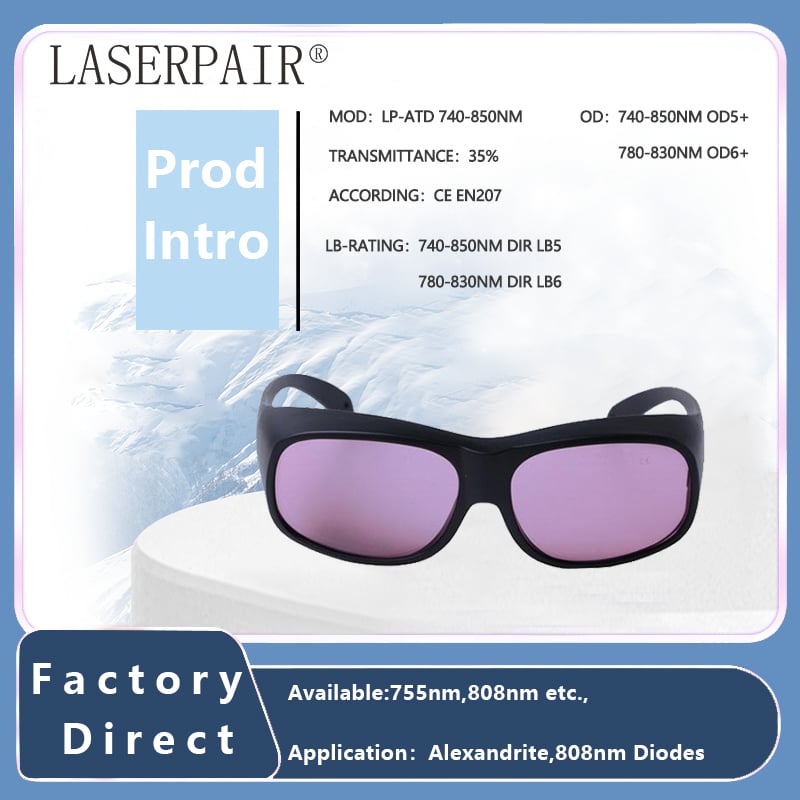
Every laser operates at a specific wavelength (measured in nm), and your safety glasses must match this wavelength—otherwise, they’re as useless as regular glasses. No exceptions!
Common laser wavelengths include:
|
Wavelength |
Laser Type |
Typical Applications |
|
355 m |
UV laser |
Fine processing, medical treatments |
|
532 nm |
Green laser |
Alignment, medical procedures, research |
|
808 nm / 980 nm |
Diode laser |
Industrial manufacturing, medical therapies |
|
1064 nm / 1070 nm / 1080 nm |
Fiber laser |
Metal cutting, welding, marking |
|
10600 nm |
CO₂ laser |
Non-metal cutting, medical use |
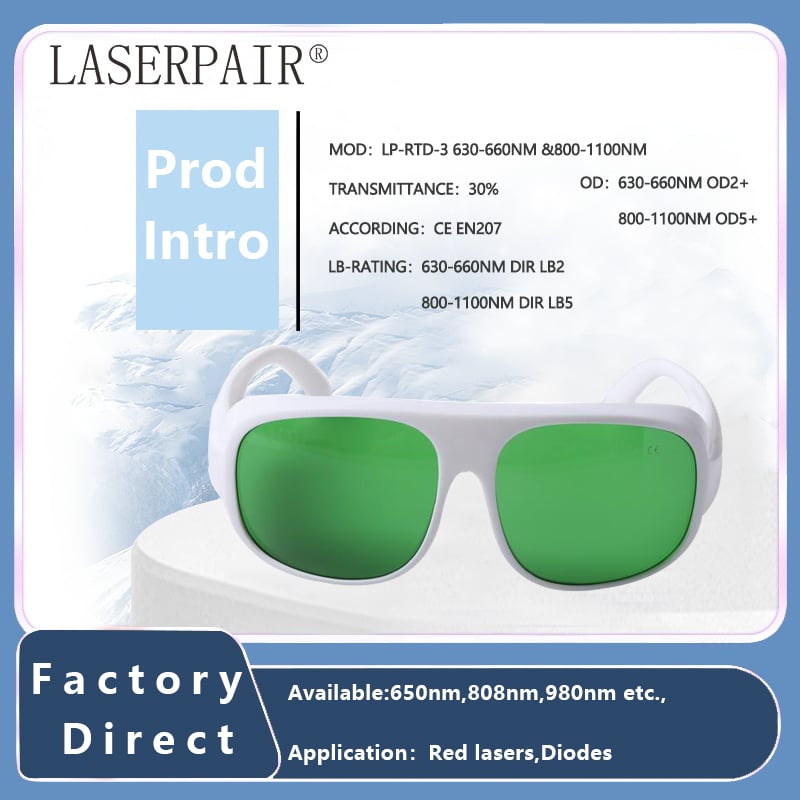
If your laser operates at 1064 nm, you must choose glasses that provide protection at 1064 nm. If you use multiple lasers with different wavelengths, you may need glasses that offer multi-band protection—or multiple pairs.
⚠️ Critical Reminder: Using the wrong wavelength filter = wearing no protection at all. Don’t take this risk!
Step 2: Check the OD Value
OD (Optical Density) measures how effectively the glasses attenuate laser energy at a specific wavelength. The higher the OD, the stronger the proection.
how to choose the right OD for your laser power?
|
Laser Power |
Recommended OD |
|
Low power (e.g., pointers, alignment) |
OD 3+ |
|
10–100 W industrial lasers |
OD 4–5 |
|
800–1500 W industrial lasers |
OD 7+ |
|
1500 W+ high-power lasers |
OD 7+ |
⚠️ Don’t overdo it: OD is not “the higher, the better” in allcases. Excessively high OD can darken your vision and make alignment difficult. Choose the minimum OD that meets safety requirements for your specific laser power.
VLT is the percentage of visible light that passes through the lenses. Higher VLT means clearer vision and less eye strain.
VLT below 20% → requires well-lit working environments
VLT of 30–50% → generally good balance of clarity and protection
High VLT (e.g., 60%+) → excellent visibility, often found in CO₂ laser glasses
The goal is to find the laser safety glasses that gives you enough protection and enough clarity to work safely and accurately.
|
Material |
Pros |
Best For |
|
Polycarbonate (PC) |
Lightweight, impact-resistant, cost-effective, comfortable for long wear |
General use, all-day wear |
|
Glass with coating |
Heat-resistant, scratch-resistant, ultra-durable |
High-power lasers, harsh industrial environments |
|
Composite filters |
Multi-layer protection, versatile for different wavelengths |
Multi-wavelength laser environments |
Polycarbonate is the most widely used material today because it’s lightweight, comfortable for long-term wear, and offers good impact resistance. Glass lenses are preferred in high-power settings where heat and durability are concerns.
Never buy laser safety glasses without proper certification. Reputable products should comply with at least one of these standards:
Check that the glasses are clearly labeled with the certification, wavelength coverage, and OD rating.
Even the best-protective glasses are useless if they’re uncomfortable and you don’t wear them consistently.
Uncertified products—no matter how cheap—are not worth the risk to your eyesight.
❌ “The darker the lens, the safer it is.” — False. Lens color has no direct correlation with laser protection—wavelength and OD are what matter.
❌ “One pair fits all lasers.” — False. Wavelength-specific protection means you need the right pair for each laser.
❌ “OD 7+ is always better.” — Not necessarily. Excessive OD can impair visibility and make alignment dangerous.
❌ “Regular sunglasses or welding goggles work fine.” — Absolutely not. They offer zero protection against specific laser wavelengths.
Choosing the right laser safety glasses isn’t complicated—but it requires attention to detail. Wavelength first, OD second, certification always.
Your eyes are irreplaceable. Don’t cut corners on protecting them.
Laserpair Co., Limited focus on Laser Safety industry over 10 years, if you want to buy laser safety glasses, just inquiry us.
 Hot News
 EN
EN