
 EN
EN


Align Enclosure Protection Level with Laser Classification
Class 1–3R Lasers: When Passive Barriers and Administrative Controls Suffice
Class 1 to 3R lasers emit at most 5 milliwatts of visible light and generally don't need special enclosures. Simple passive measures like covered optics, beam blockers, and proper warning signs usually do the trick when paired with good administrative practices. What does this mean in practice? Well, companies should have written safety rules in place, limit who can access these lasers, train operators properly, and make sure there's someone qualified overseeing laser safety operations. Most of the time, exposure levels stay well below what's considered dangerous. The real risk comes from people staring directly at the beam for too long or intentionally looking at it despite warnings. That's why workplace guidelines need to clearly state that this kind of behavior isn't allowed under any circumstances.
Class 4 Lasers: Non-Negotiable Full Enclosures with Redundant Interlocks and Hazard Zone Mitigation
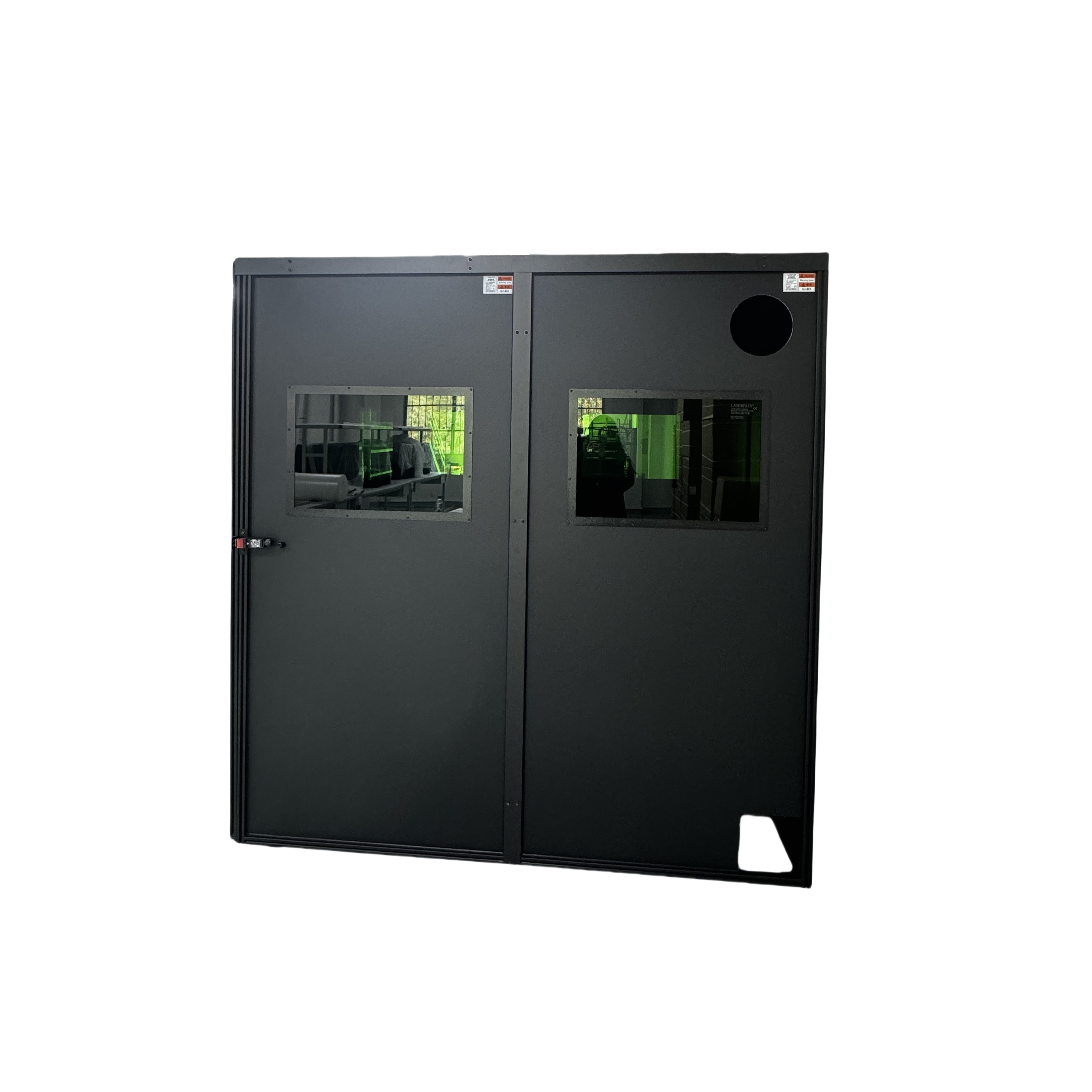
Lasers classified as Class 4 emit more than 500 milliwatts of either continuous wave or pulsed radiation, which means they need proper containment systems for safety. According to standards such as ANSI Z136.1 and IEC 60825, the basic requirement is an enclosure with multiple door interlocks that shut down the laser instantly if someone opens it accidentally. These protective housings should block not just the main laser beam but also those dangerous scattered reflections that can happen when light bounces off surfaces. They also need to handle the heat generated by powerful laser systems, especially those big CO2 lasers that operate at kilowatt levels. Safety features like emergency stop buttons, places where unused beams get safely absorbed, and cooling systems are absolutely necessary parts of any setup. The official guidelines referenced by OSHA state that whatever containment system gets used has to keep radiation levels below what's considered safe for people anywhere beyond the designated work area.
Choose Laser-Specific Enclosure Materials Based on Wavelength and Power
Material Transmission & Absorption: Matching Acrylic, Polycarbonate, and Filtered Glass to UV, Visible, and FIR Lasers
Getting good barrier performance really depends on matching the right material with the correct wavelength. Acrylic works great for visible light lasers between 400 and 700 nanometers. It lets operators see what's happening during processes while still absorbing most of the energy. When dealing with ultraviolet light below 380 nm, polycarbonate becomes the go to choice. This material can soak up nearly all incoming UV radiation thanks to how its molecules are arranged. For those longer far infrared wavelengths, particularly around 10,600 nm from CO2 lasers, there's no substitute for specially treated borosilicate glass. The metal oxides mixed into this glass stop heat damage that would destroy regular plastics over time. Looking at real world data from laser safety studies, about one out of every four containment issues in factories happens because the wrong material was used for a particular wavelength range.
Power-Derated Thickness Standards: Ensuring Laser Safety at 10 W (Diode) vs. 5 kW (CO₂)
When it comes to material thickness requirements, what really matters is power density rather than just looking at the nominal wattage numbers. And here's something important: the relationship isn't linear but exponential when we talk about derating principles. Take for instance a small 10 W diode laser which can actually work fine with only 3 mm of polycarbonate protection. Now compare that to a much bigger 5 kW CO2 system where safety demands anywhere between 15 to 25 mm of laminated, filtered glass equipped with special cooling films. These advanced materials need to handle impressive energy loads too, around 980 joules per square centimeter before they fail thermally. Most safety professionals rely on the Lambert-Beer law as their go-to tool for calculating the necessary barrier thickness. They consider factors like how much light gets absorbed, the spread of the beam, and those tricky pulse characteristics that vary so much across different applications. What follows next are some standard practices that have stood the test of time in real world engineering scenarios.
| Laser Power | Material | Minimum Thickness |
|---|---|---|
| ≤100W | Acrylic/Polycarbonate | 5mm |
| 1–3kW | Tempered Glass | 12mm |
| >4kW | Laminated Filtered Glass | 18mm+ |
This approach is especially critical for pulsed lasers, where peak power can exceed nominal ratings by orders of magnitude.
Verify Compliance-Critical Safety Systems and Certifications
Interlock Architecture: Dual-Channel Design and Fail-Safe Logic per ANSI Z136.1 and IEC 60825
At the heart of every Class 4 laser enclosure sits the interlock system, which basically controls everything when it comes to safety. Standards like ANSI Z136.1 and IEC 60825 set strict rules for these systems. They require what's called dual-channel architecture where two separate circuits must detect an access problem before the laser beam gets shut down. The thinking here is pretty straightforward actually. By having backup monitoring for doors, service panels, and those rubber seals around them, we remove the risk of one small failure causing catastrophe. When dealing specifically with Class 4 equipment, manufacturers have to implement cross wiring between components and ensure response times stay below 10 milliseconds. Getting certified involves some serious testing too. Engineers run fault injection tests and validate entire sequences just to prove they meet SIL 2+ standards required by most industrial automation protocols today.
Laser Safety Viewing Windows: OD Ratings, Spectral Validation, and ISO 13849 Performance Level (PLd)
When it comes to viewing windows, they need proper testing for specific wavelengths instead of just getting a generic certificate. The Optical Density (OD) rating should be above what's needed for the job at hand. For visible lasers, we typically look for OD 4 or higher, whereas infrared sources such as CO2 systems require something closer to OD 7. This ensures that the light passing through stays under safe exposure limits. Different materials get tested differently based on their properties. Polycarbonate gets checked for how well it blocks UV radiation, while filtered glass needs verification regarding its ability to reduce far infrared transmission. According to ISO 13849 standards, these safety windows have to meet Performance Level d (PLd) requirements, which basically means there shouldn't be more than one dangerous failure every 10,000 hours of operation. Safety mechanisms called mechanical interlocks are built into systems so that if someone damages a window during maintenance work, the laser automatically shuts down. Regular checks happen once a year too, looking at things like surface scratches, any cloudiness caused by UV exposure, worn seals around the edges, and whether everything remains securely mounted where it should be. These annual inspections help keep operations within regulatory boundaries.
FAQ Section
What are the primary differences between laser classes when it comes to safety?
Class 1 to 3R lasers emit lower power and generally do not require special enclosures. Class 4 lasers, in contrast, require full enclosures with redundant interlocks due to their high power output.
Why is it important to match enclosure materials with laser wavelength and power?
Matching materials with the correct wavelength ensures maximum absorption and safety. For instance, acrylic is suitable for visible light lasers, polycarbonate for UV light, and specially treated glass for far infrared wavelengths.
How do interlock systems function in ensuring laser safety?
Interlock systems are dual-channel and designed to shut down the laser immediately if access is breached. This minimizes the risk of exposure and maintains safety standards.
What are the key certifications needed for laser enclosure compliance?
Compliance with ANSI Z136.1 and IEC 60825 is essential, as these standards dictate the safety and efficiency of interlock systems. Viewing windows must also meet ISO 13849 standards for performance levels.
Table of Contents
- Align Enclosure Protection Level with Laser Classification
- Choose Laser-Specific Enclosure Materials Based on Wavelength and Power
-
Verify Compliance-Critical Safety Systems and Certifications
- Interlock Architecture: Dual-Channel Design and Fail-Safe Logic per ANSI Z136.1 and IEC 60825
- Laser Safety Viewing Windows: OD Ratings, Spectral Validation, and ISO 13849 Performance Level (PLd)
- FAQ Section
- What are the primary differences between laser classes when it comes to safety?
- Why is it important to match enclosure materials with laser wavelength and power?
- How do interlock systems function in ensuring laser safety?
- What are the key certifications needed for laser enclosure compliance?