
 EN
EN


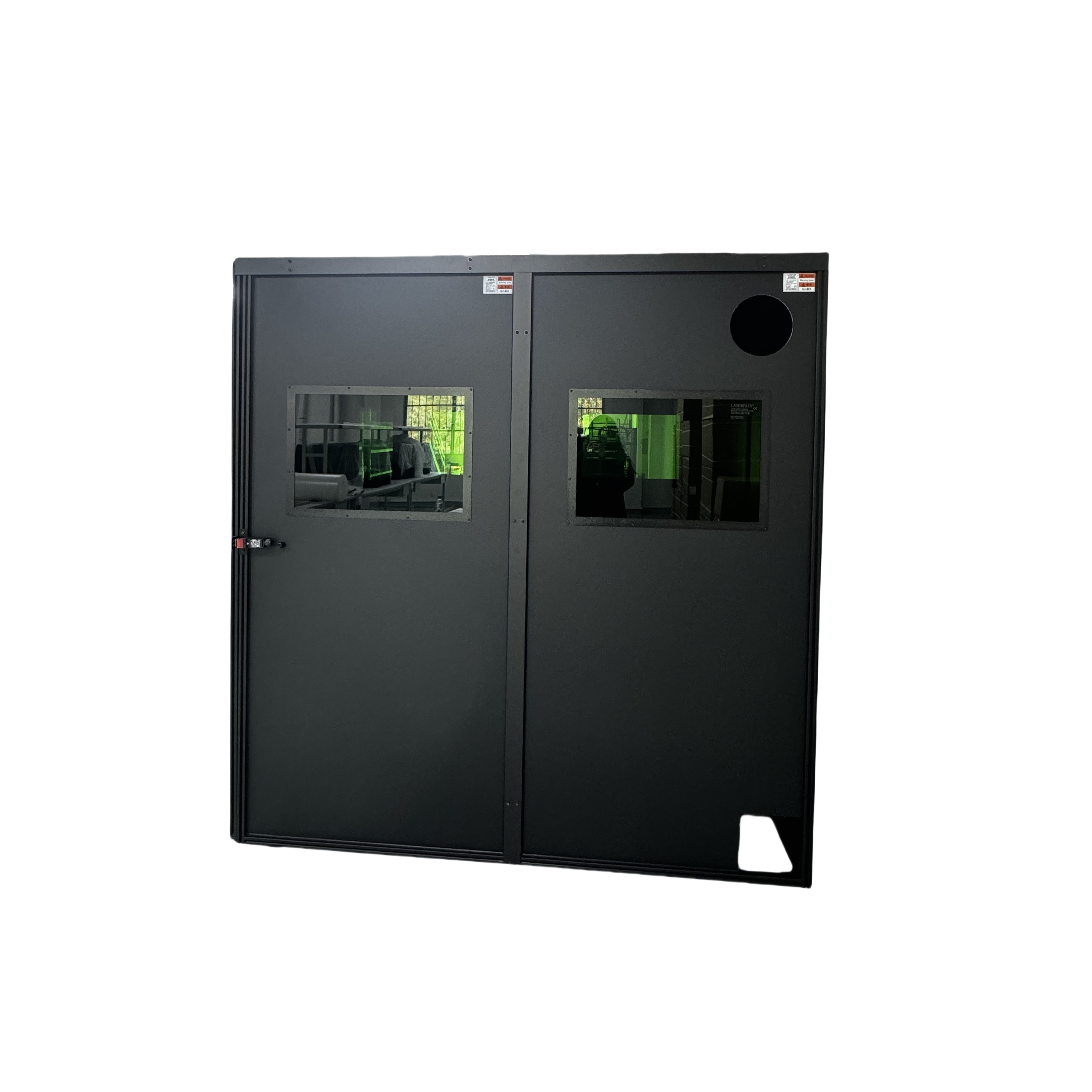
Designing Laser Safety Cabins with Regulatory Compliance in Mind
Understanding the Problem: Failings of Pre-Fabricated Enclosures in Meeting ANSI Z136.1 and ISO 13849 Standards
Most pre-fabricated enclosures are not designed to the rigorous safety performance level of ANSI Z136.1 and ISO 13849. They have a validated interlock structure, materials for beam containment with an Optical Density (OD) certification, and optical density certification traceable safety analysis for Class 3B and Class 4 laser systems. There are numerous interlock circuits built to Category 4 performance level of ISO 13849 which ensure immediate cessation of the laser if the enclosure door or panel is breached. Without these features, they cannot be effective in defining a Laser Controlled Area (LCA). Non-compliance means exposure to an enforcement action by the OSHA, penalties, and severe losses. A laser safety cabin is designed for regulatory compliance and provides a safe space for all the Laser Safety Standards.
System-Level Integration: The Unification of Interlocks, Controls, and Hazard Analysis in Custom Laser Safety Cabins
Designing your own laser safety cabin means integrating systems. Compliance on its own fails. Interlocking systems, safety controls, and hazard analysis comprise a single, auditable solution. This process begins with a formal risk analysis per ANSI Z136.1 Annex D and ISO 13849-1. It identifies all beam and non-beam hazards in operating, maintaining, and failure modes. Category 4 rated, dual channel interlocks; safety shutters, and emergency circuits are designed and wired to a certified safety controller (e.g. SIL 3, PL e). The OD ratings, shutter response times, and Windows, and control logic are fully assessed, tested, and traceable to said standard(s). Unlike a collection of adapted solutions, this fully certified system provides a gapless solution. This system simplifies regulatory audits and presents defensible results of due diligence.
First-of-a-Kind Hazard Mitigation with Advanced Laser Safety Cabin Features
Real-Time Beam Containment: Redundant Interlocks, Safety Shutters, and Category 4 Circuit Design
When configuring a custom laser safety cabin, real-time beam containment relies on a layered, fault-tolerant architecture—not isolated components. Redundant interlocks—monitored door switches, hinged panel contacts, and proximity sensors—provide laser shut-off when breached. Safety-rated shutters are activated within milliseconds of detected interlock faults and beam-path anomalies. These systems are designed in accordance with ISO 13849’s Category 4 principles, which include dual-channel paths, self-monitoring and corrective action, and fault suppression and automatic shutdown. These systems are essential for high power industrial lasers. Integrating these features in a single platform and system saves time for certification, and reduces compliance costs for the safety cabin in the long-term.
The dangers of lasering go beyond the beam. When lasers interact with materials, they can create harmful particulates and a form of gas. This is common with cutting and engraving with metals or plastics, as well as manufacturing. To combat this, a custom cabin employs source-capture HEPA filtration with a 99.97% efficiency rate for particles 0.3 micrometers and smaller. HEPA filtration is sized and positioned to optimize the cabin design for best face velocity. Furthermore, all surfaces of the welding cabin, including walls and baffles, are made of materials that absorb or disperse harmful radiation, like OD 7+ acrylic and coated metals. This design approach addresses the two major concerns of airborne particulates and radiation. Along with the filtration system, this design approach considers OSHA PELs, ACGIH TLVs, and ANSI Z136.1 exposure limits. Ultimately, the cabin design is intended to protect workers from the harmful effects of lasers and make the workspace safe from optical hazards.
Tailored Integration of Laser Safety Cabin Configurations for Seamless Integration
Adaptable to Robotics, Conveying Systems, and Space and Accessibility Requirements
Ready-made safety cabins are frequently a source of conflict to automation. They can introduce bottlenecks to your system, constrain your robots' reach, and force expensive facility redesigns. Custom laser safety cabins eliminate friction points. This is done through systems engineering and modular solutions. We design your access points, interfaces, and dimensions to suit your needs. We can create robotic arm pass-throughs using sealed, OD-rated sleeves, conveyor zones using integrated, interlocked, and seamless designs, and support your mounting systems by integrating existing structures. We can create removable panels and sliding service access doors using durable beam containment systems. Adaptations can done to your systems quickly, whether they are dexterous cobots or ultra-rapid beam systems. These custom solutions have been shown to reduce downtime from integration by up to 40% with respect to implementing generic safety enclosures. These custom solutions also comply with ANSI Z136.1 without the need to adapt your facility.
Protecting Against Direct, Reflected, and Failure Mode Hazards for High-Power Lasers
High-power lasers present three simultaneous risk factors: direct beam hazard, unintentional specular or diffuse reflections, and failure mode scenarios such as back-reflections damaging the laser diode or arcing in the power supply. Each risk factors can be mitigated through the synchronized engineering of custom laser safety cabin design. The direct beam hazard is contained with walls and baffles made of attenuating laser absorbing composites or reflective alloys matched to the laser's wavelength and power density. The safety cabin’s interior design utilizes non-specular reflective finishes and baffles angled to scatter the laser energy. Laser energy is contained to below safe limits. Photodiode-based back reflection monitors continuously integrate the return energy. Once the monitored energy exceeds an acceptable threshold, the monitor commands the shutter to engage and a controlled shut down of the laser is initiated. This defense design ensures personnel and equipment are protected for every operational state from the routine to the disruptive.
FAQ
Q: What do ANSI Z136.1 and ISO 13849 entail?
A: ANSI Z136.1 and ISO 13849 are safety standards for laser systems. ANSI Z136.1 presents the guidance in the use of lasers and the control of hazards, and ISO 13849 provides the requirements for the design of safety-related controls.
Q: What are the advantages of purpose built laser safety cabins versus non-purpose built safety enclosures?
A: Purpose-built safety cabins are designed with the strictest safety standards in mind, with advanced interlocks, comprehensive hazard analysis, and traceable, validated materials per ANSI Z136.1 and ISO 13849.
Q: How is a custom cabin compatible with involving lasers in industrial workflows?
A: Custom laser safety cabins can be designed with robotics, conveyor systems, and facility specific “footprints” to increase workflow efficiency while also maintaining safety and minimizing disruptive alterations.
Q: What are safety measures taken in custom laser safety cabins?
A: Safety measures include HEPA filters to safely remove hazardous fumes, materials that absorb and shield against radiation, redundant interlock systems and safety shutters for fail-safe operations.
Q: What risks are posed by high-powered lasers and how are they contained?
A: With high-powered lasers direct viewing hazards, reflected hazards, and cascading effects are present. For custom safety cabins, laser absorbent materials, non-specular surfaces and fail-safes are used.