
 EN
EN


How OD Quantifies Attenuation: Physics of Logarithmic Optical Density at 1064nm and 455nm
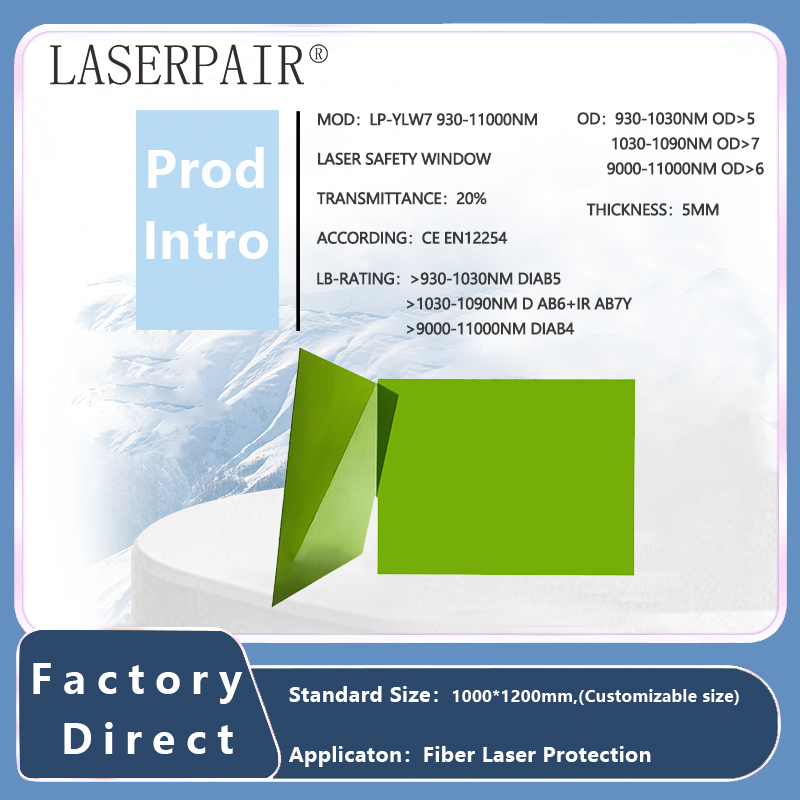
Optical Density (OD) is the core quantitative metric for evaluating laser safety window performance, specifically used to measure the degree of laser light attenuation at designated wavelengths. Calculated via a standard logarithmic formula: OD = log₁₀(incident power ÷ transmitted power), OD values reflect an exponential reduction in laser radiation, directly determining the safety protection capability of laser enclosures.
Industrial high-power laser systems commonly operate at 1064nm infrared wavelength and 455nm blue wavelength, with each wavelength carrying independent and distinct biological hazards to human eyes and skin. This makes targeted wavelength-specific attenuation indispensable for qualified laser safety windows. The exponential nature of OD delivers dramatic safety differences with small value changes: OD 3 blocks 99.9% of incident laser energy, while OD 7 achieves a 10-million-fold energy reduction, filtering out 99.99999% of laser radiation. Unlike ordinary broad-spectrum light shielding materials, professional laser safety windows must complete verified attenuation calibration for 1064nm and 455nm respectively, rather than relying on generalized broad-spectrum protection performance.
Regulatory OD Thresholds per ANSI Z136.1–2022 and IEC 60825-1 for Class 4 Laser Safety Houses
Class 4 high-power lasers are classified as high-risk industrial equipment, capable of causing instantaneous irreversible eye and skin injuries, and even triggering fire hazards. Accordingly, international authoritative standards including ANSI Z136.1–2022 and IEC 60825-1 have formulated clear and mandatory OD threshold specifications for Class 4 laser safety houses.
The minimum required OD value is not fixed; it is dynamically calculated based on core operating parameters including laser output power, beam divergence angle, effective exposure duration, and Maximum Permissible Exposure (MPE). For mainstream high-power industrial laser safety enclosures, OD 6 or higher attenuation performance is mandatory at operating wavelengths to meet safety compliance requirements. Standard compliance relies on two core indicators: accurate OD calculation based on MPE theoretical values and uniform attenuation capability across the entire viewing aperture of the safety window.
Certified laser safety windows are permanently marked with wavelength-matched OD test data, providing traceable and auditable safety verification. This standardized marking ensures industrial laser houses fully meet international regulatory requirements and avoid operational safety risks and compliance penalties caused by insufficient attenuation.
Dual-Wavelength Challenges: Achieving Reliable OD for Simultaneous IR and Blue Lasers
Material Limitations: Why Single-Layer Interference or Absorptive Designs Struggle with Broadband OD
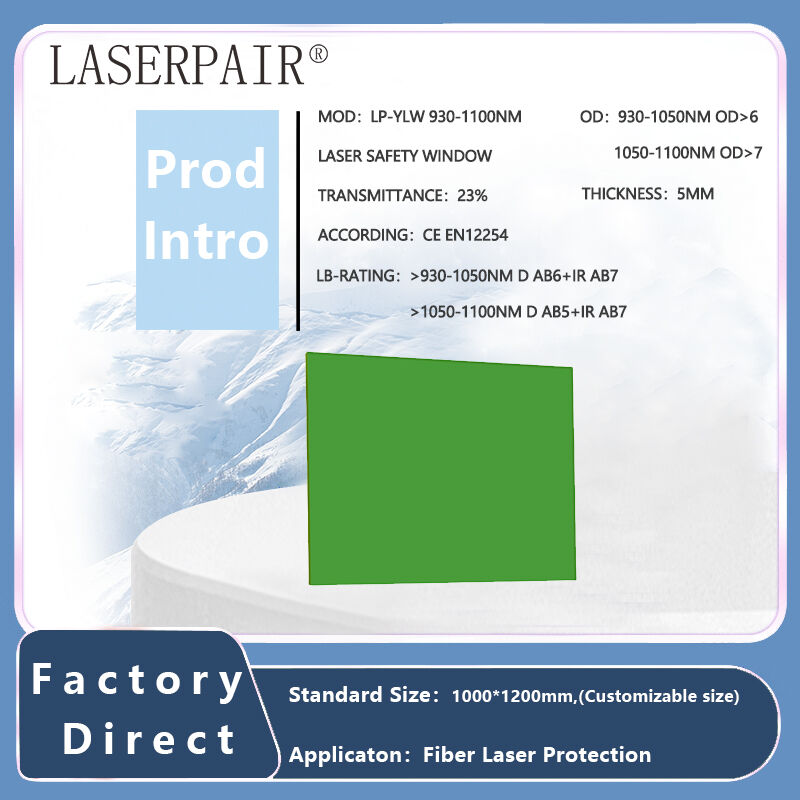
Many conventional laser safety window designs fail to meet dual-wavelength (1064nm IR + 455nm blue) high-OD protection requirements, due to inherent technical bottlenecks of single-layer structural solutions. Single-layer interference filters adopt precise quarter-wave optical stack design, which can only form high-reflectivity shielding within a narrow wavelength band. A coating optimized for 1064nm infrared laser will experience sharp performance attenuation at 455nm blue light, and the reverse is also true. This fundamental optical characteristic makes it impossible for single-layer interference coatings to achieve stable OD 6+ broadband protection for both wavelengths simultaneously.
Single-layer absorptive materials face another set of critical limitations. Dye-based absorptive films protect by converting laser light energy into heat. Under long-term high-power continuous-wave (CW) or pulsed laser irradiation, the material is prone to thermal saturation and thermal runaway, triggering sudden transmission breakthrough and complete failure of protective performance (Ponemon 2023). In addition, absorptive materials widely block visible light while attenuating laser radiation, seriously reducing operator field of view clarity and compromising the operational usability of laser safety houses. Neither single-layer interference nor single-layer absorptive structures can balance dual-wavelength high-OD safety, high-power durability, and on-site operational usability for Class 4 laser scenarios.
Hybrid and Stacked Solutions — Practical Approaches for Certified Laser Safety Window Performance
Professional certified high-power laser safety windows adopt optimized hybrid stacked architectures to break through single-material and single-layer technical bottlenecks, achieving reliable dual-wavelength high-attenuation protection. The most mature mainstream configuration combines a 1064nm-tuned reflective interference coating and a 455nm-optimized absorptive film. The infrared reflective layer safely diverts high peak-power infrared laser energy exceeding 10 MW/cm², avoiding thermal overload damage to the substrate; the matched blue light absorptive layer stably attenuates 455nm wavelength laser without thermal saturation failure.
Advanced industrial-grade solutions adopt dielectric multilayer stack structures, using alternating arrangements of high and low refractive index optical materials to form ultra-wide rejection bands covering both 1064nm and 455nm wavelengths. This precision engineering structure stably achieves OD 6+ attenuation for infrared lasers and OD 5+ attenuation for blue lasers, while maintaining over 40% visible light transmittance. It perfectly meets ANSI Z136.1 and IEC 60825-1 Class 4 laser enclosure compliance standards, ensuring zero compromise on operator sightline clarity and daily operational efficiency while guaranteeing extreme laser safety.
Balancing Safety and Usability: Transparency, Thermal Stability, and Damage Threshold Trade-Offs
Fused Silica vs. Coated Acrylic: Transmission, Thermal Lensing, and CW/Pulsed Damage Resistance
Substrate material selection determines the ultimate safety ceiling and service life of high-power laser safety windows. Fused silica has become the preferred core substrate for Class 4 laser safety equipment by virtue of its comprehensive superior performance, far outperforming traditional coated acrylic materials in light transmission, thermal stability, and laser damage resistance.
In terms of optical performance, high-purity fused silica delivers over 90% visible light transmittance, with near-zero thermal expansion characteristics at infrared wavelengths. It completely eliminates thermal lensing distortion caused by long-term continuous-wave laser operation, ensuring consistent optical clarity and accurate operator observation. In contrast, dye-absorptive or interference-coated acrylic substrates lose more than 30% visible light transmittance, resulting in dim field of view and poor environmental adaptability under variable lighting conditions.
Thermal stability is a key safety distinction between the two materials. Acrylic features low thermal conductivity (0.2 W/m·K) and a low softening point of approximately 80°C. Localized laser heating easily causes plastic deformation and refractive distortion, forming potential safety hazards. Fused silica has a high thermal conductivity of 1.4 W/m·K, which rapidly dissipates heat and avoids thermal deformation and structural failure.
In terms of laser damage resistance, fused silica withstands nanosecond pulsed laser ablation up to 15 J/cm² and maintains stable performance under long-term CW laser irradiation. By comparison, polymer acrylic materials have an ultra-low micro-melting threshold of less than 5 J/cm², prone to instantaneous damage and protective failure. Authoritative international material verification data confirms that fused silica achieves three-dimensional comprehensive advantages in transmittance, thermal stability and damage resistance, meeting the long-term safe operation requirements of high-power Class 4 laser systems.
Calculating Application-Specific OD for Laser Safety House Viewing Zones
The qualified OD value of a laser safety window is not a one-size-fits-all fixed standard. It must be accurately calculated based on actual laser system parameters and viewing zone geometric conditions to achieve customized safety protection. The entire calculation process is based on the Maximum Permissible Exposure (MPE) value specified by the ANSI Z136.1 standard, corresponding to specific laser wavelengths and exposure durations.
The core calculation logic is as follows: First, calculate the laser power density at the safety window position. The laser spot radius equals the working distance multiplied by the beam divergence angle (radian unit); the power density is obtained by dividing the total laser power by the spot area. Then substitute the power density and standard MPE value into the formula: Required OD = log₁₀(power density ÷ MPE).
A typical industrial scenario example fully verifies the accuracy of this method: a 5 kW high-power laser with 2 mrad beam divergence operating at a 1-meter working distance forms a spot radius of approximately 1 mm, with a power density as high as 160 kW/cm². Adopting the 1064nm infrared laser direct eye exposure MPE standard (5 mW/cm²), the calculated required OD value is approximately 7.5. This MPE-based precise calculation method covers extreme working conditions such as laser offset alignment and accidental exposure, ensuring the safety window can attenuate laser radiation below the harmless threshold in all scenarios.
FAQ
What is Optical Density (OD) and how is it calculated? Optical Density (OD) is a professional metric for measuring laser light attenuation performance of safety windows. It adopts a logarithmic calculation formula: OD = log₁₀(incident power ÷ transmitted power), reflecting the exponential reduction degree of laser energy.
What are the minimum OD requirements for Class 4 lasers? The minimum OD threshold is determined by laser power, beam divergence, exposure time and MPE value. Industrial high-power Class 4 laser safety houses typically require OD 6 or higher certified attenuation performance to meet international safety standards.
Why is dual-wavelength OD important in laser safety windows? 1064nm infrared and 455nm blue lasers produce different biological hazards to the human body. Safety windows must achieve qualified OD attenuation for both wavelengths simultaneously to avoid single-wavelength protection loopholes and ensure comprehensive operator safety.
What materials are recommended for high-power laser safety windows? High-purity fused silica is the optimal substrate for high-power laser safety windows, with ultra-high visible light transmittance, excellent thermal stability, and strong CW/pulsed laser damage resistance, far exceeding the comprehensive performance of coated acrylic materials.
Table of Contents
- How OD Quantifies Attenuation: Physics of Logarithmic Optical Density at 1064nm and 455nm
- Regulatory OD Thresholds per ANSI Z136.1–2022 and IEC 60825-1 for Class 4 Laser Safety Houses
- Dual-Wavelength Challenges: Achieving Reliable OD for Simultaneous IR and Blue Lasers
- Balancing Safety and Usability: Transparency, Thermal Stability, and Damage Threshold Trade-Offs
- Calculating Application-Specific OD for Laser Safety House Viewing Zones
- FAQ