
 EN
EN


The Role of Optical Properties in Laser Safety Window Performance
Fundamental Purpose of Laser Safety Windows in Controlled Environments
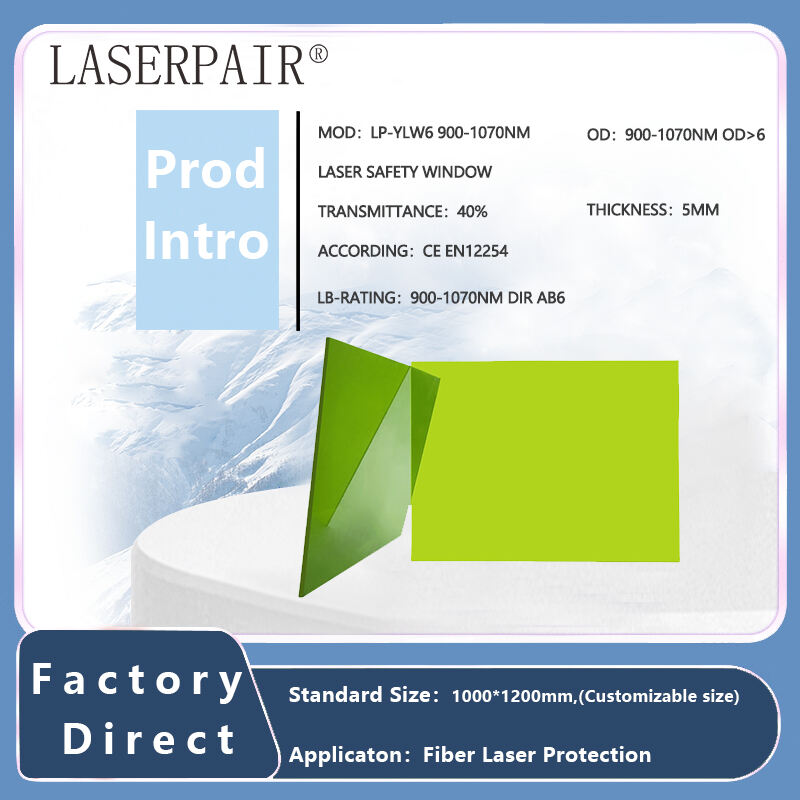
Safety windows designed for lasers play a critical role across various settings including factories, hospitals, and labs that work with high power lasers classified as either Class 3B or 4. What makes them different from regular glass? These special windows stop dangerous laser beams but still let through enough visible light so workers can actually see what's happening during procedures. This dual protection works wonders against two main risks: getting hit directly by the beam itself and those tricky indirect reflections bouncing off surfaces. According to recent studies published in Occupational Safety Review back in 2023, around 62 percent of all injuries caused by lasers at workplaces come from these very reflections. Pretty staggering number when you think about it.
How Optical Properties Define Protective Performance in Laser Safety Windows
The effectiveness of Laser Safety Windows depends on three key optical properties:
- Wavelength-specific attenuation: Blocks specific laser emissions (e.g., 1064 nm for Nd:YAG lasers)
- Optical density (OD): Ranges from OD 4+ for low-power systems to OD 7+ for high-power industrial applications
- Scatter resistance: Minimizes reflected energy via anti-reflective coatings
Together, these ensure transmitted radiation remains below the Maximum Permissible Exposure (MPE) limits defined by international safety standards.
Regulatory Standards Shaping Optical Design (ANSI Z136, IEC 60825)
Compliance with ANSI Z136.1 and IEC 60825 governs critical performance parameters:
| Standard | Transmission Requirement | Durability Test |
|---|---|---|
| ANSI Z136.1 | <0.1% at target wavelength | 50 J/cm² pulsed IR |
| IEC 60825 | OD ≥5 for Class 4 lasers | 200-hour UV stability |
Manufacturers must also meet ergonomic benchmarks such as ≥70% visible light transmission (VLT) and wavefront distortion under 0.5%. The IEC 60825-1:2023 update now mandates multi-wavelength protection for facilities using diverse laser types.
Key Optical Transmission Characteristics for Effective Laser Protection
Wavelength-Specific Attenuation and Its Impact on Laser Safety Windows Efficiency
Eye protection works by blocking specific wavelengths of light, which is measured using something called Optical Density or OD. When we talk about an OD rating of 5, what that really means is the material blocks out almost everything except for 0.001% of the laser light passing through it. The European standard EN207 rates protective eyewear on a scale from L1 to L10 based on how well they stop different types of laser radiation. Take an L6 rating for instance it stops 99.9999% of laser light at 1064 nanometers but still lets about 15% of regular visible light come through. This balance allows workers to see clearly enough to do their job safely while keeping their eyes protected from harmful exposure.
Balancing Visible Light Transmission With Laser Blocking Capabilities
Laser safety windows today rely on those fancy multi-layer coatings that help strike a balance between being able to see through them and actually providing proper protection. Take these seven layer chromium/silica filters for instance they manage around 30% visible light transmission but still block nearly all that pesky 532 nm green laser light with an OD4 rating. The latest standards from ANSI Z136.1-2022 specify that labs need at least 18% visibility and surgical areas require about 25%. Makes sense really because doctors and researchers still need to see what they're doing without making mistakes during procedures.
Measuring Spectral Transmittance: Tools and Protocols for Validation
Certified testing relies on standardized tools and procedures:
| Tool | Measurement Range | Compliance Standard |
|---|---|---|
| Spectroradiometers | 190–2500 nm | ISO 11551 |
| OD Meters | 200–11000 nm | EN207:2023 Annex B |
Testing occurs at 20° incidence angles and 100 W/cm² irradiance to simulate operational stress. Annual recertification ensures OD stability within ±0.1 units, maintaining long-term compliance.
Material Selection and Coating Technologies for Optimal Optical Performance
Comparative analysis of polycarbonate, acrylic, and glass in Laser Safety Windows
When talking about laser safety materials, polycarbonate stands out because it can take serious impacts without cracking, plus it absorbs well at that specific 1064 nm wavelength needed for Nd:YAG lasers. Most people need protection rated around OD 6 or higher, so this material checks all those boxes. Acrylic is another option worth considering, especially since it lets through most visible light, sometimes as much as 92% depending on the formulation. It also stops both UV and IR radiation, which makes it good enough for teaching labs where students are working with lower power lasers. Glass has always been prized for how clear it stays over time and its ability to handle chemicals without degrading, though nobody wants to deal with shattered glass when something goes wrong. That's why many factories stick with polycarbonate for their heavy duty needs, even though acrylic still finds plenty of use in smaller mobile equipment where weight matters more than absolute durability.
Coating technologies enhancing optical filtering and durability
The right coating can make all the difference for materials in demanding applications. Take multi layer dielectric coatings for instance they work great at blocking certain wavelengths like those pesky 10.6 micrometer CO2 laser lines while still letting around 70% of visible light through. That's pretty impressive when we need optical components that block harmful radiation but stay transparent enough for visual inspection. Anti reflective coatings are another game changer reducing surface glare down to less than 0.5% reflection which means much less stray light messing up sensitive equipment readings. For industries dealing with harsh environments diamond like carbon coatings offer remarkable protection against scratches lasting anywhere from three to five times longer than regular surfaces. These DLC treated parts survive hundreds of cleaning procedures without showing wear even in sterile pharmaceutical settings where cleanliness is absolutely critical. Looking ahead some manufacturers are experimenting with new combinations that mix UV resistant nanoparticles with water repelling top coats these hybrid solutions seem promising for preventing fog buildup and material breakdown in moist industrial atmospheres.
Degradation of optical properties under prolonged laser exposure
Materials tend to break down over time when they're constantly exposed to harsh conditions. Take polycarbonate for instance it typically loses around 15 to 20 percent of its light transmission capability after about 10,000 hours at 50 watts per square centimeter because the molecules start breaking apart. Acrylic material gets even worse when subjected to really intense laser beams above 5 megawatts per square centimeter at 1064 nanometers wavelength, causing tiny cracks to form across the surface. Glass stands out as particularly stable until it hits that critical point called laser induced damage threshold (LIDT) which sits around 100 megawatts per square centimeter for short pulse lasers, though it can still develop color changes close to where thermal expansion becomes problematic. Testing has shown that materials with protective coatings maintain roughly 90 percent of their original effectiveness after running nonstop for eight whole years, whereas those without coatings drop down to just 65 percent performance. That makes these coatings absolutely essential for things like spacecraft components and medical devices where long lasting reliability matters most.
Laser-Induced Damage Threshold and Long-Term Optical Durability
Defining Laser-Induced Damage Threshold (LIDT) for Laser Safety Windows
The laser-induced damage threshold, commonly known as LIDT, basically tells us how much energy or power a window material can handle before it gets damaged permanently. When dealing with pulsed lasers, we measure this value in joules per square centimeter (J/cm²), whereas continuous wave systems use watts per square centimeter (W/cm²) instead. Small imperfections on surfaces such as scratches or issues with coatings often become problem areas where heat builds up, which ultimately reduces what the window can actually withstand. To check if materials meet safety standards, manufacturers run tests following specific protocols. These include single pulse testing (the 1-on-1 method) and multiple pulse testing (called S-on-1). The results need to pass both ANSI Z136 and IEC 60825 guidelines to ensure proper protection levels for operators and equipment alike.
Impact of Pulse vs. Continuous Wave Lasers on Optical Materials
When it comes to pulsed lasers, they actually create damage without heat, thanks to this fast ionization process that generates shock waves and those pesky subsurface fractures. Continuous wave (CW) lasers work differently though, slowly breaking things down thermally until materials start to melt, especially common plastics such as polycarbonate and acrylic. Some research from last year found something interesting about this difference. They tested CW lasers at around 1 kW per square centimeter and saw acrylic start to deform after just half a minute. But when they tried pulsed lasers with similar average power levels, the material simply vaporized right away. Choosing the right material matters a lot depending on which kind of laser will be used. Glass tends to hold up much better against the heat generated by CW lasers, but if someone is dealing with pulsed lasers instead, polycarbonate seems to handle those powerful shockwaves significantly better than other options.
Strategies for Extending Service Life Through Optical Resilience Engineering
To maximize longevity:
- Multi-layer coatings improve LIDT by 40–60% in polycarbonate (industry testing, 2024)
- Beam homogenization distributes energy evenly, reducing localized stress
- Predictive maintenance uses real-time spectral monitoring to detect early degradation
- Thermal diffusion layers in laminated glass composites enhance heat dissipation
These approaches support compliance with evolving ISO 21254-2 guidelines, ensuring durable optical performance across decades of use.
Emerging Trends in Smart Optical Filtering for Next-Generation Laser Safety Windows
Electrochromic and Liquid Crystal Integration in Dynamic Laser Safety Windows
The latest generation of dynamic windows combines electrochromic materials with liquid crystal layers, creating optical filters that adjust themselves almost instantly when laser intensity changes. These advanced systems let through more than 75% of visible light but can block out extremely strong lasers with an OD rating above 7 across wavelengths from 1,064 to 10,600 nanometers. Research published last year showed that these windows actually last for well over 100,000 activation cycles without any drop in performance, which solves one of the biggest problems people had with earlier versions of adaptive filters. This kind of durability makes them much more practical for real world applications where reliability matters most.
Real-Time Adaptive Filtering: The Future of Intelligent Laser Safety Windows
AI-driven systems now employ MEMS-based spectral sensors and machine learning to anticipate and neutralize emerging laser hazards. Innovations include:
- Multi-wavelength synchronization for mixed-laser workspaces
- Cloud-connected control enabling facility-wide optical safety networks
- Failure-prediction analytics that reduce unplanned downtime by 62% (Laser Safety Journal, 2024)
This intelligent approach avoids over-engineering while ensuring adherence to ANSI Z136.1 and IEC 60825-4 standards.
Cost-Benefit Analysis of Smart Versus Passive Laser Safety Windows
Although smart windows carry a 35–50% higher initial cost, they offer 40% lower total lifecycle expenses due to:
- Extended replacement intervals (12 years vs. 5 years)
- 80% reduction in auxiliary lighting energy consumption
- Elimination of manual shielding protocols
A 2024 industry survey found that 78% of aerospace R&D facilities with budgets exceeding $2M now prioritize smart windows, reflecting growing adoption in high-risk, high-value environments.
FAQs
What are the main optical properties affecting laser safety windows?
The main optical properties are wavelength-specific attenuation, optical density (OD), and scatter resistance.
Why are coatings important for laser safety windows?
Coatings enhance laser safety windows by reducing reflections, improving visibility, and protecting against long-term wear and UV damage.
How do dynamic laser safety windows work?
Dynamic windows use electrochromic materials and liquid crystal layers to adjust their optical properties in response to changes in laser intensity.
What standards must laser safety windows comply with?
Laser safety windows must comply with standards such as ANSI Z136.1 and IEC 60825, which govern transmission and durability requirements.
What is Laser-Induced Damage Threshold (LIDT)?
LIDT is the measure of energy or power a material can handle before becoming permanently damaged by laser exposure.
Table of Contents
- The Role of Optical Properties in Laser Safety Window Performance
- Key Optical Transmission Characteristics for Effective Laser Protection
- Material Selection and Coating Technologies for Optimal Optical Performance
- Laser-Induced Damage Threshold and Long-Term Optical Durability
- Emerging Trends in Smart Optical Filtering for Next-Generation Laser Safety Windows
- FAQs